
table of contents
AI Loss Prevention ROI Analysis: Accurate Calculation Methods for Enterprises
Why Upgrading Loss Prevention Is Urgent
Global retail losses amount to nearly 500 billion US dollars annually, and traditional loss prevention methods are increasingly showing obvious limitations. Our research findings reveal critical pain points of traditional approaches:
Manual inspections fail to detect about 40% of potential problems, and post-event video review is slow and inefficient, leading to passive risk response.
Traditional methods have three core drawbacks: slow response (about 60% of losses are irrecoverable due to delayed action), heavy staff reliance (around 30% of operating costs are spent on low-value routine checks), and isolated data (poor system connectivity makes early risk warning difficult to implement).
AI loss prevention solutions leverage computer vision technology to achieve real-time abnormal behavior detection, cutting response time to mere seconds. A well-known international fast-moving consumer goods brand reduced its loss rate by 18 percentage points after deploying such solutions, which vividly demonstrates the practical value of technological upgrades in loss prevention.
A Practical AI Loss Prevention ROI Model
Calculating the ROI of AI loss prevention projects requires a comprehensive breakdown of costs and accurate measurement of benefits, abandoning the one-sided calculation logic of traditional methods.
🔗AI Checkout Loss Prevention: A Complete Guide
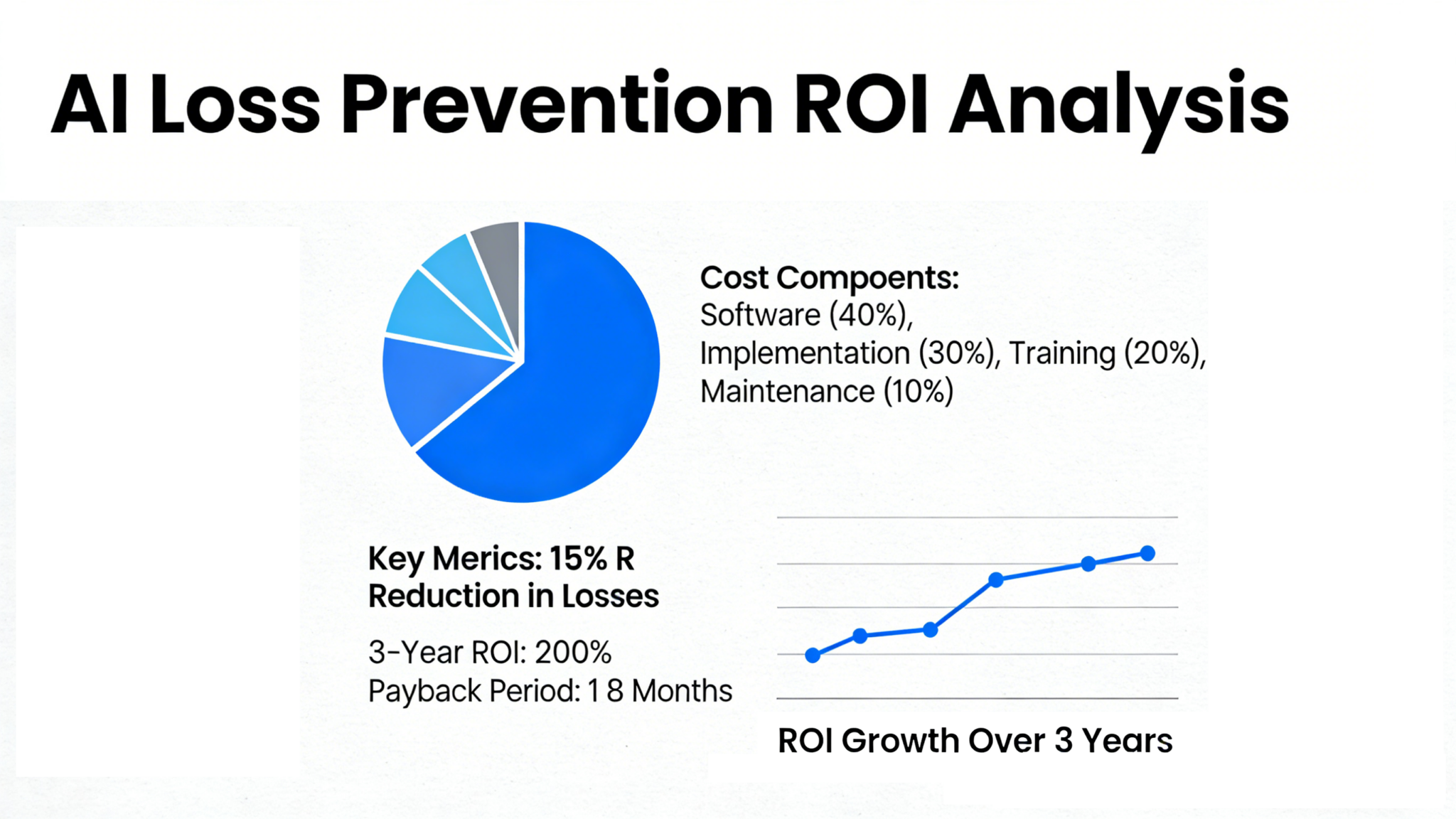
H3: Detailed Cost Breakdown of AI Loss Prevention Projects
Enterprises need to consider all cost components in project planning, including explicit and hidden costs, to avoid budget deviations:
- Hardware costs (30% of total budget):
- Cover smart cameras and edge servers, the core infrastructure for video capture and real-time data analysis, laying the foundation for the operation of AI loss prevention systems.
- Software costs (45% of total budget):
- Include algorithm licenses and platform management fees. High-quality algorithms directly improve detection accuracy, while a robust management platform optimizes data utilization and system operation efficiency.
- Hidden costs (25% of total budget):
- Often overlooked but crucial, including data cleaning and system integration. Clean data is a prerequisite for effective AI analysis, and integrating new AI systems with existing IT systems is more complex than expected, requiring professional technical support.
Winmore Digital’s AI Loss Prevention Solution for Self-Checkout
Winmore Digital has launched a targeted self-checkout loss prevention system, which upgrades existing self-checkout machines with high-performance AI cameras and advanced algorithms, featuring self-learning and automatic loss detection capabilities. Its core advantages are as follows:
High accuracy: Real-time analysis of customer scanning behavior, detecting missed scans and wrong barcodes with an average risk transaction detection rate of over 90%.
Fast deployment: Front-end integration mode enables installation in about 10 minutes, shortening project launch time, reducing pilot costs, and adapting to stores of all sizes.
Real-time monitoring and alerts: Full-process monitoring of checkout links, identifying unscanned items, intentional bypass, and barcode mismatches, sending instant alerts and recording events for subsequent review.
Strong compatibility: Supports Windows, Linux, and Android systems, seamlessly connecting with existing POS and checkout systems without major system overhauls.
Comprehensive Measurement of AI Loss Prevention Benefits
Enterprises should not only focus on direct loss reduction but also fully tap into the hidden benefits of AI loss prevention systems, which account for more than 35% of the total return according to industry research:
Direct benefit: Significant loss reduction: Real-time detection and rapid response effectively reduce retail shrinkage, the most intuitive return of AI loss prevention projects.
Hidden benefit 1: Improved customer experience: Fewer checkout disputes reduce customer complaints and increase the Net Promoter Score (NPS) by 12%.
Hidden benefit 2: Higher operational efficiency: The system generates automatic restocking lists, reducing manual labor input by 30% and optimizing daily store operations.
Hidden benefit 3: Insurance cost savings: Better risk management and lower loss rates help enterprises obtain better risk ratings, thus reducing insurance premiums.
McKinsey’s research data shows that mature AI loss prevention projects can achieve a comprehensive ROI of 1:4.3, proving the high economic value of such projects for enterprises.
Key Factors Affecting AI Loss Prevention ROI
Several core factors directly influence the ROI of AI loss prevention projects, and enterprises need to focus on optimization and control:
Accuracy effect: ROI rises sharply with the improvement of detection accuracy. When accuracy increases from 85% to 90%, the return growth is significant. For a store with 20,000 daily customers, every 1% increase in accuracy can bring an additional annual loss prevention benefit of about 87,000 US dollars.
Scale effect and data challenges: For enterprise groups with thousands of stores, the average cost per store can be reduced to 60% of a single-store setup due to scale effect. However, unified lighting and shelf layouts are required across stores; otherwise, excessive environmental differences will lead to a decline in AI model performance and affect detection accuracy.
Future Trends of AI Loss Prevention
The development of AI loss prevention is moving towards multi-modal integration, and its value is no longer limited to simple loss reduction, but extended to business operation and marketing decision-making:
Multi-modal technology integration: Future AI loss prevention systems will combine voice recognition, heat maps, and consumer behavior models, achieving more comprehensive and accurate risk detection.
Transformation of loss data into business assets: Loss data collected by the system can be deeply analyzed to understand consumer behavior and shopping habits, providing data support for store marketing strategies and shelf layout optimization, helping enterprises increase revenue and enhance core competitiveness.
Three-Step Approach for Accurate AI Loss Prevention ROI Calculation
Winmore Digital proposes a scientific three-step approach to help enterprises calculate AI loss prevention ROI accurately and dynamically, reducing project risks:
Baseline calculation: Use professional industry templates to comprehensively estimate all project costs and potential benefits, establishing an initial ROI baseline.
A/B testing: Launch pilot projects in partial stores, verify the rationality of baseline assumptions through actual operation data, and adjust the calculation model in a timely manner.
Dynamic monitoring: Build a real-time ROI dashboard, track project operation data in real time, continuously optimize the AI model and system operation, and update ROI data dynamically to ensure the long-term high return of the project.
Conclusion
The calculation of AI loss prevention ROI is not a static one-time process but requires continuous adjustment and optimization with project operation and technological upgrades. The ultimate goal of enterprise AI loss prevention is not only to reduce retail shrinkage but also to dig out the hidden business value behind loss data, transform risk management into a new driving force for revenue growth, and enhance the overall market competitiveness of enterprises.
For enterprises exploring AI loss prevention projects, accurate ROI calculation is the key to decision-making. By mastering scientific calculation methods and focusing on the core factors affecting returns, enterprises can better grasp the opportunities of technological upgrading and realize the dual value of risk control and business development.