TL;DR

If you sell retail software or checkout hardware, the question is no longer whether stores need smarter loss prevention cameras. The question is which camera setup actually works in supermarkets, convenience stores, and grocery environments without creating friction, false alerts, or expensive infrastructure requirements.

The most practical AI shoplifting detection cameras are not defined by headline specs like 4K resolution. They are defined by five things that affect store performance:

  1. Coverage of the real checkout action area.
  2. Stable detection of item movement, not just people in frame.
  3. Low false-alert control for hands, phones, glare, and empty trays.
  4. Lightweight compute requirements that fit existing retail hardware.
  5. Easy integration with POS and self-checkout workflows.

That matters because store economics and buyer priorities are shifting. Avery Dennison reports that 64% of large retailers in the US and UK say theft has reached a crisis point, while 38% plan to deploy AI-enabled cameras within 24 months (Avery Dennison). ECR Retail Loss also notes that stores with more self-checkout usage and machine density can see materially higher loss, and that retailers are increasingly evaluating overhead video-based systems to identify scan avoidance (ECR Retail Loss).

For retail software vendors and hardware partners, the opportunity is clear: build around camera systems that are accurate enough for live intervention, but light enough to deploy at scale. That is exactly where WmDigital’s approach stands out. Its practical deployment profile is notably low: support for Windows on J1900 / 4GB RAM and Android on RK3288 / 2GB RAM, USB-connected cameras, and a parameter model built around fast calibration rather than heavy infrastructure.

Why This Topic Matters Now

Retail theft is not a theoretical problem. It is a live operating issue that is reshaping how stores think about self-checkout, staffing, and customer flow.

Retailers also cannot solve loss by simply adding friction everywhere. Tony D’Onofrio cites the 2024 Digital Commerce Index showing that 43% of consumers favor self-checkout in grocery, while Avery Dennison says theft is now the top business challenge for surveyed retail leaders at 36%, ahead of omnichannel optimization and operating costs (Tony D’OnofrioAvery Dennison). In grocery and convenience environments, that pressure is amplified because:

  • Self-checkout adoption remains high.
  • Small basket speed matters.
  • Teams are lean.
  • High-frequency items are easy to mis-scan or substitute.
  • Aggressive controls can damage customer experience.

That is why AI shoplifting detection cameras are becoming less of a surveillance discussion and more of a workflow design decision.

What AI Shoplifting Detection Cameras Actually Need to Do

For supermarkets, convenience stores, and grocery chains, an AI loss prevention camera is useful only if it can support a real store behavior model.

In practice, that means the camera system should be able to:

  • Detect when an item enters and exits the real scan zone.
  • Distinguish a product from a hand, phone, or incidental motion.
  • Match physical item movement with barcode or POS events.
  • Flag likely missed scans, scan avoidance, and wrong-item scans in real time.
  • Work on current store hardware without forcing a full checkout rebuild.

This is also where many buyers go wrong. They compare cameras like security buyers, when they should compare them like retail operations buyers. For checkout loss prevention, megapixels alone do not solve shrink. Calibration quality, response timing, false-alert handling, and integration overhead matter more.


The Camera Parameters That Matter Most in Retail Loss Prevention

Below are the camera-related parameters that matter most when evaluating AI shoplifting detection cameras for retail environments.

1. Detection Area Design

The first question is not resolution. It is whether the camera can reliably watch the actual action area where scanning happens.

In self-checkout and assisted checkout, the useful camera field is usually a narrow operating zone in front of the scanner, not the full counter or aisle. A good retail AI camera setup should let teams define:

  • An action detection area for item movement.
  • An image recognition area for visual item capture.
  • A practical distance range from the camera to the scan zone.

This matters because over-wide scenes create noise, and under-sized scenes miss the item completely. In grocery and convenience deployments, a tighter, well-calibrated scan zone usually outperforms a wider but less disciplined camera view.

2. Trigger Timing and Response Speed

Retail camera systems need to react at store speed. If they trigger too slowly, missed scans slip through. If they trigger too fast, false alerts rise.

In WmDigital’s iDetector deployment model, practical starting values include:

  • Detection interval400ms
  • Detection trigger time400ms
  • Wrong-scan threshold0.8
  • Entry threshold0.18
  • Exit threshold0.1

These numbers are useful not because every store should copy them blindly, but because they show a key point for retail software and hardware partners: effective store AI can run on a lean, operations-driven parameter set instead of a highly complex tuning model.

3. False-Alert Control

One of the fastest ways to kill adoption is to deploy cameras that fire too many alerts.

In retail, false alerts usually come from:

  • Hands moving through the scan area.
  • Phones or payment screens entering view.
  • Reflection and lighting noise.
  • Empty tray or empty counter conditions.
  • Inconsistent item placement.

This is why anti-noise logic is essential. In the iDetector setup, there is support for obstruction filtering and empty-tray detection, with an example empty-tray threshold of 0.97. There is also guidance to adjust trigger sensitivity when low-quality depth signals create white noise in the frame.

For store operators, that translates into a simple buying rule: do not evaluate AI shoplifting detection cameras only on detection rate. Evaluate them on how well they suppress non-productive interventions.

4. Distance and Mounting Tolerance

Many real-world deployments fail because the camera works in a demo booth but not on a live retail counter.

In stores, installers need a system that tolerates imperfect mounting conditions and still allows fast setup. A practical retail camera solution should support:

  • Measured distance calibration.
  • Adjustable upper and lower detection bounds.
  • Quick re-tuning for different counter layouts.
  • Repeatable templates for the same hardware model.

WmDigital’s approach is notable here because teams can start with a broad distance range, then refine to measured working values. In example guidance, camera-to-zone values like 900 to 1200 are used as workable references, with manual fine-tuning available where needed. That makes rollout easier for hardware vendors deploying the same counter form factor across multiple stores.

5. Low Compute and Low Hardware Thresholds

This is where the commercial story becomes especially strong for ISVs and hardware providers.

Many retailers do not want a shrink-reduction project that requires:

  • New GPU infrastructure.
  • High-power industrial PCs.
  • Major counter redesign.
  • Extra external power and complex rewiring.

WmDigital’s camera and AI deployment profile is unusually light:

  • Windows: minimum guidance includes J1900 / 4GB RAM / 64GB storage / Windows 7
  • Android: minimum guidance includes RK3288 / 2GB RAM / 16GB storage / Android 7
  • Camera connectionUSB, with no separate external camera power requirement
  • CPU consumption: around 20%
  • Deployment: about 10 minutes for software and hardware installation in the stated deployment model

For a retail software vendor, this means a broader install base. For a hardware partner, it means less BOM pressure. For the store, it means faster rollout with less operational disruption.



Why Low Camera and Hardware Requirements Matter Commercially

For many retail technology buyers, the winning argument is not “most advanced AI.” It is “fastest path to stable store rollout.”

That is especially true in:

  • Supermarkets, where checkout density and throughput matter.
  • Convenience stores, where counter space and staff coverage are limited.
  • Grocery stores, where frequent produce, packaged goods, and quick-basket shopping create repeated scan-risk moments.

When AI shoplifting detection cameras can run on lower-spec retail devices, software vendors and hardware partners gain three advantages:

Faster Sales Cycles

Buyers are more likely to move forward when they do not have to redesign the entire checkout environment.

Better Retrofit Economics

A lighter parameter and hardware profile helps stores upgrade existing lanes instead of replacing them.

Easier Multi-Store Standardization

When the system can be deployed with reusable templates and modest hardware needs, scaling from pilot to estate rollout becomes simpler.


Where These Cameras Create the Most Value

Supermarkets

Supermarkets need AI camera systems that can handle:

  • High transaction volumes
  • Frequent self-checkout usage
  • Produce and variable packaging
  • Barcode mismatch risks
  • Busy peak-hour traffic

Here, the right camera is not just a theft camera. It is a checkout operations camera.

Convenience Stores

Convenience stores need compact, low-friction systems because the store team is often minimal. The value of AI shoplifting detection cameras here comes from:

  • Fast alerts
  • Lightweight hardware
  • Minimal intervention burden
  • Better protection for high-theft daily items

Grocery Stores

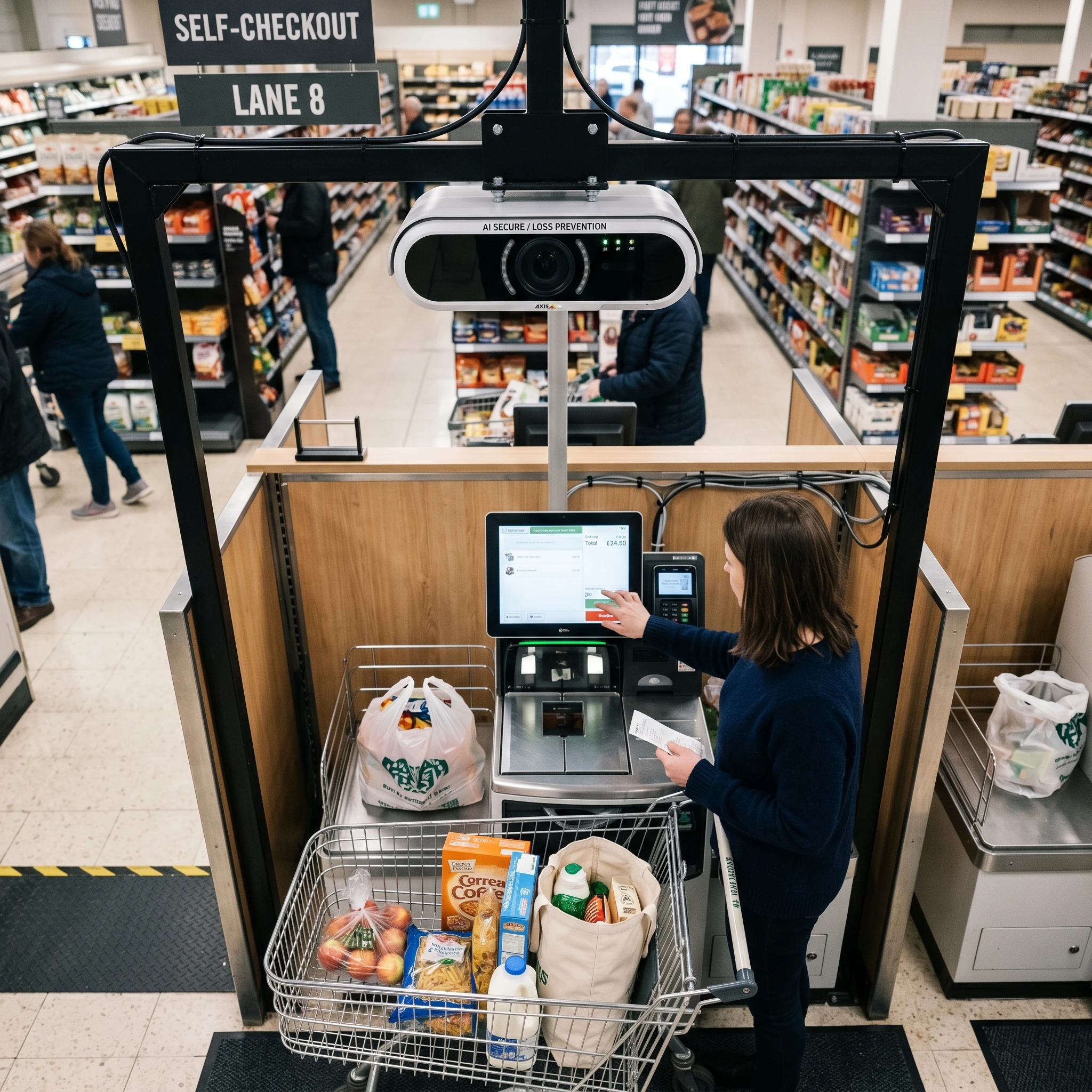
Grocery environments need more than aisle surveillance. They need item-level checkout visibility. That is where overhead AI camera design becomes especially useful, because it can monitor scan behavior rather than simply record people after the fact.

ECR Retail Loss specifically highlights retailer interest in video-based systems that use overhead cameras to compare item movement around the scan area with EPOS registrations (ECR Retail Loss). That makes the camera discussion directly relevant to checkout loss, not just general store security.


A More Practical Way to Compare AI Shoplifting Detection Cameras

If you build retail platforms or retail devices, use this checklist instead of a generic CCTV checklist.

Ask These Questions

  1. Can the camera reliably define the checkout action zone?
  2. Can it distinguish item movement from hand or phone movement?
  3. Can it handle real store lighting and glare?
  4. Can it run on existing checkout hardware?
  5. Can it integrate with barcode, POS, or transaction events?
  6. How quickly can the lane be calibrated and replicated?
  7. What is the false-alert burden on staff?

Be Careful With These Red Flags

  • Very high hardware requirements for ordinary lanes
  • Heavy dependence on cloud inference for live response
  • No practical calibration workflow
  • No logic for empty tray, obstruction, or scan-zone tuning
  • Good demo accuracy but no clear store deployment model


Why This Matters for Retail ISVs and Hardware Vendors

This market is not just about selling cameras. It is about helping stores modernize checkout loss prevention without adding friction.

Retail ISVs can use AI shoplifting detection cameras to strengthen:

  • self-checkout software
  • AI transaction monitoring
  • barcode mismatch workflows
  • exception handling
  • store analytics

Hardware vendors can use them to strengthen:

  • kiosk differentiation
  • retrofit readiness
  • low-power device compatibility
  • rollout economics
  • channel partner value

In other words, the camera has become a product strategy decision, not just a security accessory.


If you are building retail software, self-checkout hardware, or smart kiosk solutions, this is the right time to rethink what your camera layer should do.

  • Want a lighter path to AI checkout loss prevention? Start with the camera and parameter model.
  • Want to reduce rollout friction for grocery and convenience clients? Prioritize low-spec compatibility.
  • Want to add a stronger commercial story to your product stack? Pair AI cameras with transaction-aware loss prevention.
your ideal retail AI solutions provider

view related content