
table of contents
Are you looking for a efficient  retail AI solutions?

discover how we help you!

AI Weighing Applications in Self-Service and Smart Retail

As smart retail continues to evolve, traditional weighing methods are struggling to keep up. Long queues in fresh food areas, slow self-checkout caused by manual PLU input, and inconsistent product data across stores all create friction for both customers and retailers.

AI self-service weighing is changing this reality. By combining visual recognition with intelligent algorithms, AI weighing systems transform non-barcoded product checkout from a retail pain point into a seamless experience. In this article, we explore key AI weighing use cases and how they are reshaping smart retail applications across self-service and automated store environments.

Self-Service Checkout Areas: Truly Frictionless Weighing

Self-service checkout is where retail efficiency is tested most. Traditional weighing often relies on customers manually entering PLU codes, which quickly becomes a bottleneck during peak hours.

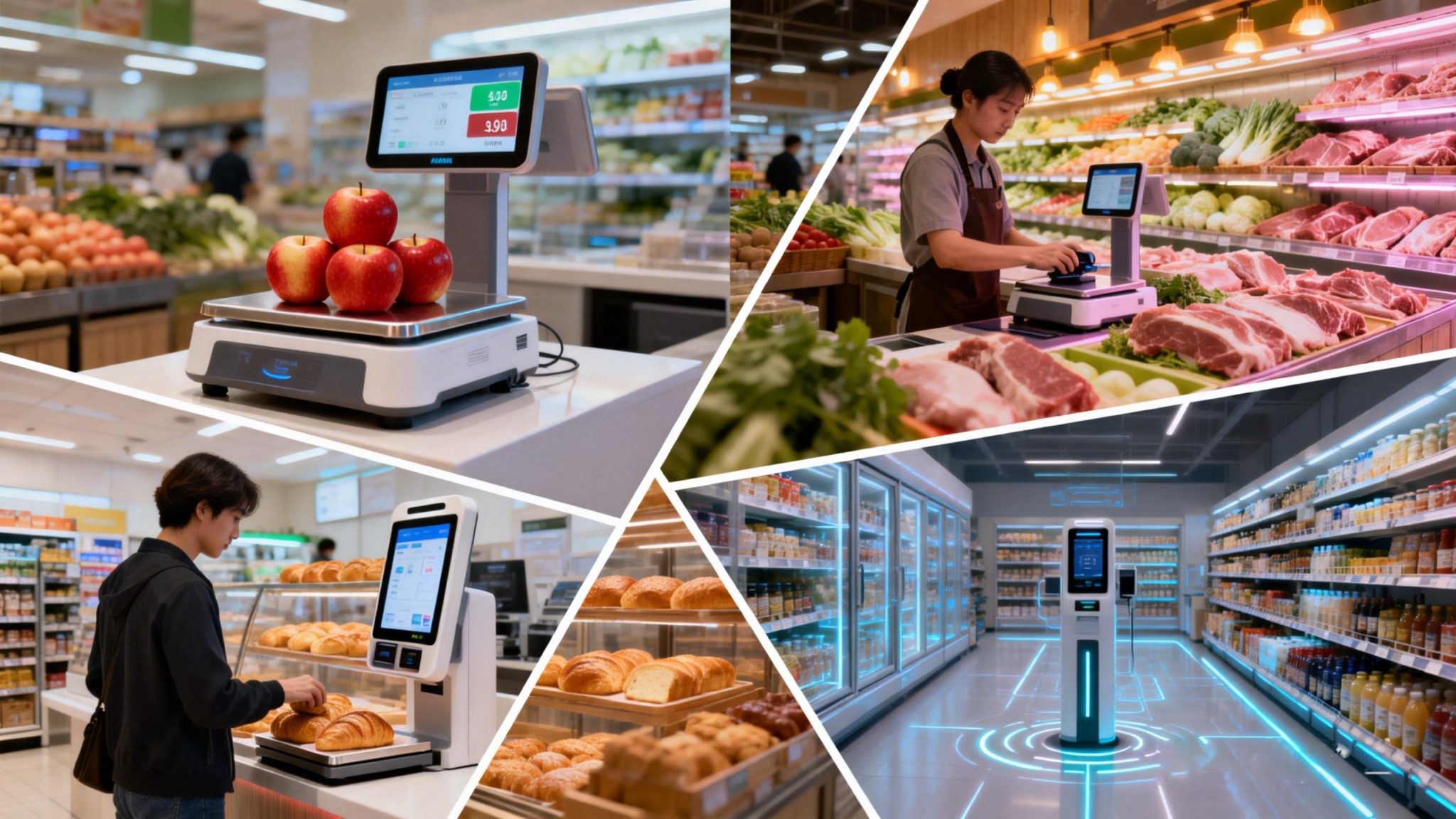
AI self-service weighing removes this step entirely. With recognition speeds as fast as 0.1 seconds and accuracy exceeding 99%, customers simply place unpackaged items—such as fruits, vegetables, or bulk snacks—on the scale. The system instantly identifies the product, displays the weight and price, and allows checkout with a single confirmation.

Even visually similar items, like different apple varieties or semi-transparent packaged goods, can be accurately distinguished. As a result, checkout time per customer is reduced by up to 60%, while errors, refunds, and staff intervention are significantly minimized.

Supermarkets and Fresh Food Sections: The Smart Weighing Assistant

Fresh food areas are one of the most complex retail environments. Staff must remember hundreds of PLU codes, while customers often wait in line for assistance.

AI weighing systems address this challenge with broad product coverage. They support recognition of vegetables, fruits, meat, seafood, nuts, and ready-to-pack fresh items—often covering more than 200 categories. Pre-trained retail datasets enable immediate recognition of common products, even in newly opened stores.

More importantly, local offline training allows stores to add new items quickly. With just one photo and a simple confirmation process, store staff can train new products without cloud dependency or technical expertise.

Retailers adopting AI weighing in fresh sections often see weighing efficiency increase by over 40%, while customer waiting time is cut in half—freeing staff to focus on service rather than repetitive tasks.

Convenience Stores and Express Retail: Lightweight Intelligence for Small Spaces

Convenience stores and express retail formats demand fast deployment and low hardware requirements. AI weighing systems are designed precisely for these environments.

They run smoothly on cost-effective hardware and support Windows, Android, and Linux platforms, eliminating the need for expensive upgrades. For stores with frequent product changes, centralized data synchronization ensures that once a product is added, all in-store devices update automatically.

In busy convenience stores, AI weighing enables quick identification of items such as bakery goods or prepared foods, allowing customers to weigh and pay independently. Many retailers report higher peak-hour sales and reduced labor costs as a result.

Smart Stores and Unattended Retail: Built for Automation and Privacy

Unattended retail and smart stores require systems that are both autonomous and secure. AI weighing systems support fully offline operation, ensuring that product recognition, pricing, and transaction data are processed locally without reliance on constant network connectivity.

This approach not only improves reliability but also strengthens data privacy. Product data remains on-site, meeting strict security and compliance requirements. In unattended environments, customers can select items, complete weighing automatically, and pay without human involvement—creating a smooth, contactless shopping experience.

Scaling Across Multiple Locations: Standardization for Chain Retailers

For chain retailers, consistency and scalability are critical. AI weighing supports centralized product management, enabling headquarters to train new products once and distribute them across all locations.

New stores can be deployed rapidly by importing an existing product library, reducing setup time from weeks to days. Retail chains using AI weighing often reduce duplicate training work by up to 90% while significantly lowering maintenance and operational costs.


Conclusion: Redefining Efficiency in Smart Retail

From instant self-service checkout to fully automated retail environments, AI weighing is becoming a foundational technology in smart retail. By improving speed, accuracy, scalability, and user experience, AI self-service weighing simplifies one of retail’s most complex processes.

As algorithms continue to improve and hardware becomes more accessible, AI weighing will play an even greater role in enabling efficient, customer-friendly, and scalable retail operations worldwide.

your ideal retail AI solutions provider

view related content