
Retail Loss Prevention: Complete Guide for Modern Retailers
Retail loss prevention is no longer just “security.” It is an operational discipline focused on reducing shrink while keeping stores fast, friendly, and profitable.
This pillar page explains the core concepts, the major loss types, why checkout is the highest-risk area, and how modern AI solutions (computer vision, deep learning, edge AI) help retailers detect and prevent loss in real time.
1. What is Retail Loss Prevention
Retail loss prevention is the set of people, processes, and technologies used to reduce preventable loss across the retail lifecycle—from receiving and stocking to checkout and returns.
The goal is measurable improvement in shrink and store operations, not only incident response.
What is Retail Shrink
Shrink is the gap between expected inventory (what systems say you should have) and what is actually available to sell. Shrink can show up as missing inventory, lost margin, write-offs, or unexplained variance.
Shrink is typically driven by a mix of:
- External theft (shoplifting)
- Internal theft (employee theft and collusion)
- Checkout loss (missed scans, wrong scans, and manipulation)
- Process errors (inventory mistakes, receiving discrepancies)
- Fraud and abuse (refund fraud, return fraud)
2. Types of Retail Loss
In order to better understand retail loss prevention, we first need to figure out what retail losses include. Retailers usually see shrink concentrate into a few repeatable loss patterns.
Shoplifting
Shoplifting includes concealment, tag switching, “push-out” attempts, and distraction-based theft. It is often opportunistic, but professional groups can scale these tactics across many locations.
Employee Theft
Employee theft can be direct (taking product/cash) or indirect (collusion, policy overrides, fraudulent voids). Because employees have access and familiarity with store processes, internal loss can be harder to detect.
Checkout Fraud※
Checkout is where inventory becomes revenue—so small failure rates can become large losses at scale.
Checkout fraud often includes:
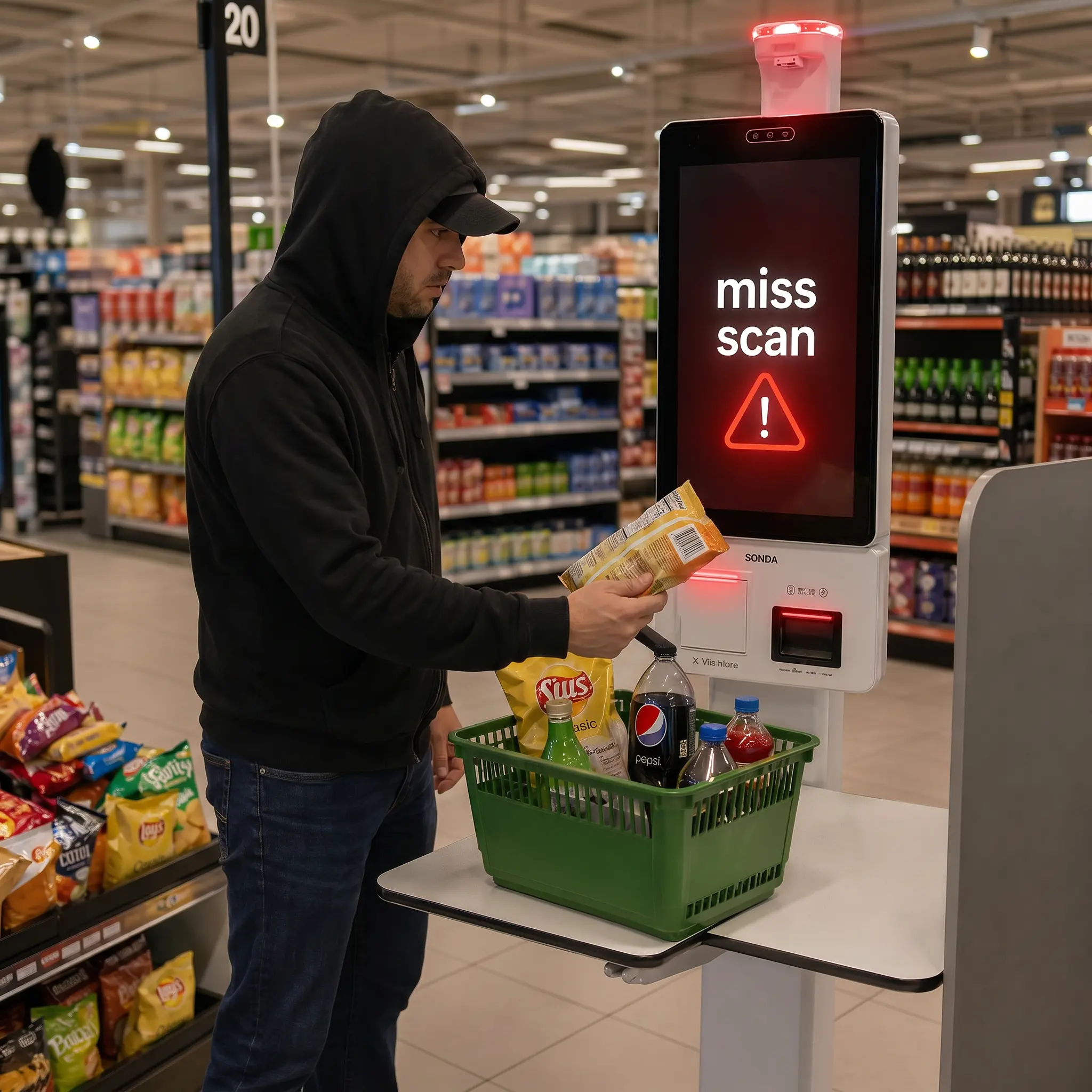
- Missed scan / skip scanning (Scan Avoidance): items are bagged without a valid scan
- Wrong scan / barcode switching: scanning a cheaper barcode while taking a higher-value item
- Obstruction behaviors: blocking the camera/scan flow to create ambiguous events
Self-checkout increases throughput, but it also increases the number of untrained “cashiers” scanning items—making checkout fraud a priority for modern loss prevention programs.
3. Why Checkout is the Highest-Risk Area
Retail theft can happen anywhere, but checkout is uniquely high-risk because:
- It is the last point to prevent loss before goods leave the store
- It combines physical behavior (items moving) with digital records (POS scans)
- High lane volume creates “attention gaps” for staff
- Self-checkout shifts scanning responsibility to customers, increasing error and manipulation
For many retailers, improving checkout controls is the fastest path to measurable shrink reduction.
4. Traditional vs AI Loss Prevention
Traditional loss prevention approaches can still matter—but they are often reactive and labor-intensive.
Rule-Based vs AI-Driven
Rule-based systems rely on predefined logic (for example: weight thresholds, fixed exceptions, manual audits). They can work for simple scenarios but often miss new fraud patterns and generate false alarms when real-world conditions change.
AI-driven systems learn patterns from visual and behavioral signals, adapt to variation, and scale to high-volume environments with better consistency.
Manual Monitoring vs Automation
Manual monitoring does not scale well at self-checkout.
- One attendant cannot reliably observe every scan, every bagging motion, and every suspicious exception across multiple lanes.
- Standard CCTV is useful for investigation, but it is rarely enough for prevention.
Automation matters most at checkout because it enables real-time validation and intervention, not just after-the-fact review.
5. Retail AI Checkout Loss Prevention
AI checkout loss prevention focuses on preventing loss while the transaction is still happening by combining video understanding with POS context.
Common AI checkout capabilities include:
- Computer vision (CV) item/behavior understanding: understanding what happened in the lane
- Skip scanning / missed scan detection: detecting bagging actions without registered scans
- Wrong scan / barcode mismatch detection: detecting when the scanned barcode does not match the visual item
- Fresh produce validation support: reducing mismatches in high-variance categories
If you are evaluating a solution specifically for self-checkout risk, see the dedicated solution page:
- Self-checkout solution: https://www.wmdigit.ai/loss-prevention-ai-self-checkout-solution/
6. Technologies Used
AI loss prevention is not one technology. It is a system built from multiple components.
Computer Vision
Computer vision helps systems interpret camera feeds: recognizing items, hands, scan motions, and bagging events. For checkout, CV is valuable because it measures what physically happened, not only what the POS recorded.
Deep Learning
Deep learning models help identify complex patterns (fake scans, subtle motion cues, object similarity) that are hard to capture with fixed rules.
In practice, deep learning can help reduce false positives while improving detection coverage for real-world behavior.
Edge AI
Edge AI means processing happens locally (on-device or on-site) instead of waiting for cloud round trips. For checkout, edge processing matters because:
- Alerts must be low-latency to intervene before payment completes
- Stores may have weak or variable connectivity
- Privacy and operational resilience can improve when critical logic runs locally
7. Best Practices
Loss prevention performance is a combination of technology and operational design.
1) Start With the Highest-Impact Loss Zones
Prioritize where shrink concentrates:
- Self-checkout lanes
- High-theft categories near exits
- Produce and weighed goods where mismatches are frequent
2) Define What “Good” Looks Like
Before rollout, align on:
- Shrink reduction goals (overall and checkout-specific)
- Exception rate (alerts per 100 transactions)
- True-positive rate vs false-positive rate
- Staff response process (who acts, how, and when)
3) Design Intervention for Customer Experience
The best systems prevent loss without creating friction:
- Clear, friendly prompts
- Minimal interruptions
- Consistent staff workflows
4) Integrate With Checkout Operations
Technology should support real checkout realities:
- Lane throughput
- Mixed hardware fleets
- POS compatibility requirements
- Deployment speed and maintenance overhead
8. Talk to a Loss Prevention Expert
If checkout shrink is rising, the fastest way to reverse the trend is to add real-time detection and intervention at the lane.