
table of contents
How AI Object Recognition Works in Weighing Systems
The Challenge of Identifying Unpackaged Products
Have you ever felt frustrated by long lines at the fresh produce weighing counter in a supermarket?
Staff members rush to remember or search for PLU codes, while customers wait impatiently. This common scene highlights a long-standing problem in retail: identifying unpackaged products.
Items like apples, leafy greens, or bulk snacks do not have barcodes. Unlike packaged goods, they cannot be scanned instantly. Instead, they rely on manual input, staff experience, or lookup lists.
This traditional process has clear drawbacks:
- Low efficiency – entering a PLU code takes around 3–5 seconds per item
- High error rates – similar products are often confused
- High labor costs – dedicated staff are required
In fact, weighing fresh products can account for up to 40% of total checkout waiting time. Helping weighing systems “understand” what they see has become a key step toward smarter retail operations.

Computer Vision in Retail Environments
AI object recognition gives traditional weighing systems a pair of smart eyes.
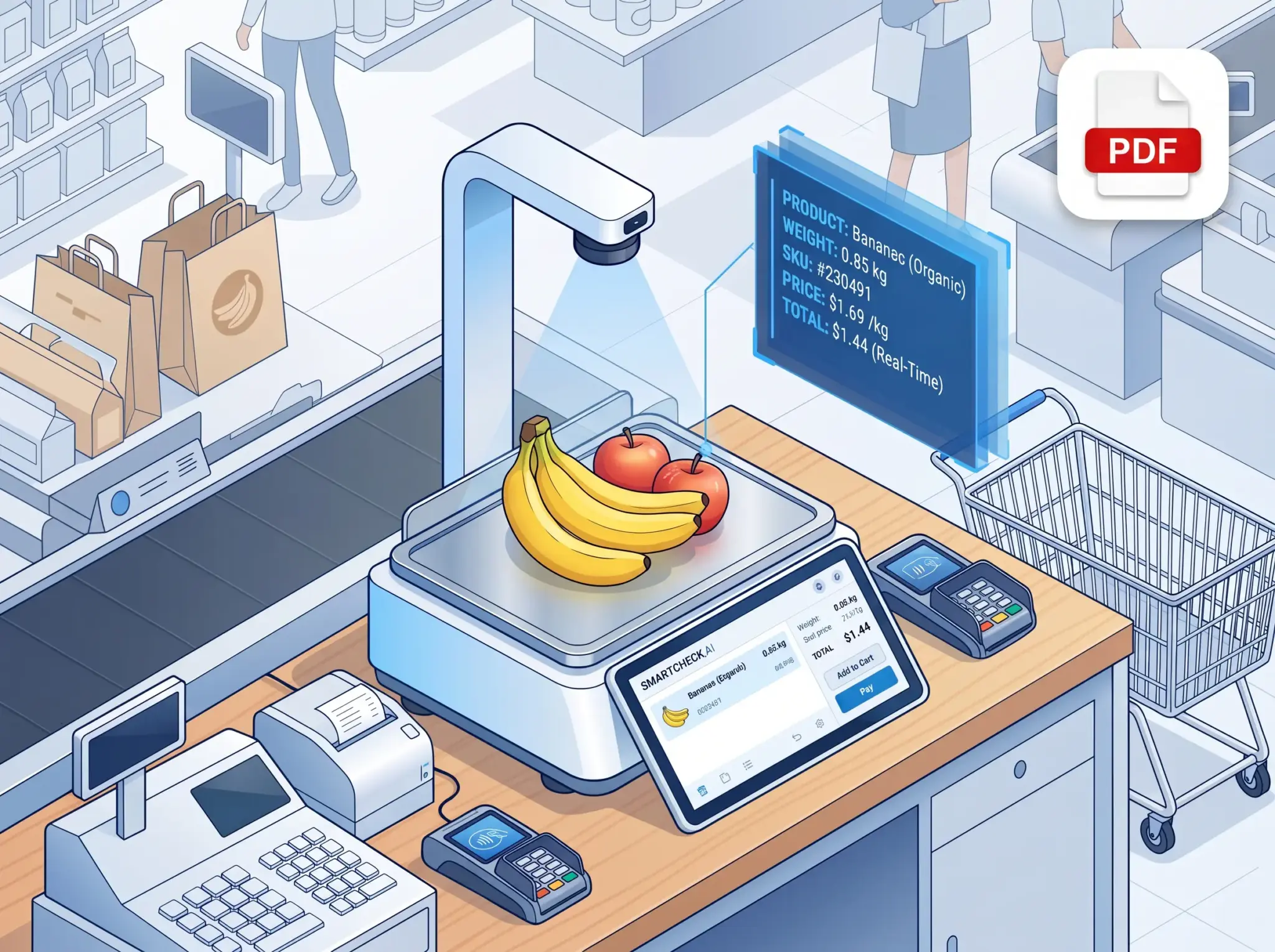
In retail scenarios, these eyes are made up of high-resolution cameras and real-time image analysis software. When a product is placed on the scale, the camera captures images from different angles. The system then analyzes visual features such as color, shape, and texture—much like how humans tell an apple from an orange.
Retail environments are far more complex than controlled industrial settings. Lighting conditions change, products may be dirty, stacked, or placed inside plastic bags. Because of this, computer vision weighing systems must adapt to real-world conditions.
Modern AI weighing technology can:
- Recognize items through semi-transparent plastic bags
- Maintain stable accuracy under different lighting
- Distinguish between visually similar products, such as apples from different origins
This adaptability allows AI-based weighing systems to work reliably in most supermarket scenarios.
AI Models Behind Product Recognition
At the heart of AI object recognition lies deep learning.
These systems are trained on large datasets to build a visual “knowledge base” of products. The process usually includes:
- Pre-trained models
- AI systems often come with thousands of pre-trained product categories, covering most common fruits, vegetables, and bulk items found in retail stores.
- Visual feature learning
- Using convolutional neural networks (CNNs), the model learns details such as the texture of strawberries, the curve of bananas, or subtle differences in packaging.
- Local learning and adaptation
- When new products appear, store staff can train the system with just one photo. The process takes only a few simple steps and does not require cloud access or technical expertise.
This combination of pre-training and local learning makes AI weighing systems both fast to deploy and easy to customize.
Combining Visual Data with Weight Data
AI object recognition becomes truly powerful when combined with weight data.
Once a product is visually identified, the system automatically retrieves its unit price. It then calculates the total price based on the measured weight—all in real time. The process follows a smooth flow: recognition → weighing → pricing.
There are two common application modes:
- Label scale mode
The system prints a price label after recognition and weighing. Customers attach the label and pay later at checkout. This is common in large supermarkets. - Checkout scale mode
The recognition result is sent directly to the POS system. Customers can weigh and pay immediately, which significantly speeds up checkout in convenience and community stores.
By integrating computer vision weighing with pricing and payment systems, weighing becomes part of a complete checkout workflow instead of a separate step.
Accuracy, Speed, and Continuous Learning
The true value of AI weighing technology is reflected in the customer experience:
- High accuracy
- The correct product appears in the recommendation list in up to 99% of cases. Over time, many systems can directly suggest a single correct item with minimal human input.
- Ultra-fast response
- From placing the product on the scale to seeing the result takes about 0.1 seconds, even on cost-efficient hardware.
- Continuous improvement
- Misrecognition cases are recorded and used to improve the model. In chain stores, new product data can be shared across locations, greatly reducing repeated training work.
From manually entering PLU codes to instant visual recognition, AI object recognition is reshaping how weighing systems work. When products can be seen, weighed, and priced in one smooth step, checkout lines shrink and shopping feels effortless.
That is the real value of computer vision weighing—bringing both efficiency and a more human shopping experience to modern retail.