table of contents
Are you looking for a efficient  retail AI solutions?

discover how we help you!

Vision AI for Retail : A Commercial Guide for ISVs & OEMs

1. Executive Summary

If you sell retail software (POS/ERP/self-checkout) or retail hardware (scales, kiosks, cameras, edge boxes) into supermarkets, convenience stores, and grocery chains, Vision AI for Retail is now a productization decision—not a science experiment.

Here’s what changes when Vision AI runs on the edge with strong integration patterns:

  1. Faster “weighing & item selection” workflows (produce + non-standard items)
    • iScale supports a drop-and-recognize flow and reports 0.1s recognition speed and 99% candidate-list accuracy in product materials, plus 90%+ top-1 after usage-driven learning.
    • It supports tens of thousands of SKUs, and can run offline with multi-OS compatibility (Windows/Android/Linux) in our materials.
  2. Better checkout integrity at scale (self-checkout exceptions)
    • iDetector is designed around video stream behavior analysis and real-time alerting + evidence capture workflows (from our manuals and solution deck).
    • In our iDetector solution material: large malls can see self-checkout share >65%, and exception detection accuracy is stated as >90%, with typical deployment described as ~10 minutes, plus a CPU envelope reference of ~20%.
  3. Faster cafeteria/ready-to-eat checkout with rapid menu iteration
    • iCanteen claims up to 99% recognition accuracy, supports complex lighting/angles, and supports new item learning from a single photo (from our iCanteen product PDF).

Why this matters commercially (not academically):

  • NRF reports U.S. retail shrink at 1.6% of sales (and $112.1B in 2022), which makes “process accuracy” a board-level KPI—especially in high-volume front-of-house flows.
  • NCR Voyix (via an Incisiv study) reports 53% of food & grocery retailers have mature self-checkout adoption, suggesting the checkout surface area for Vision AI continues to expand.

Our recommended implementation path for ISVs/OEMs:
Start with one “high-frequency, high-friction” workflow (produce weighing, SCO exception handling, or cafeteria trays), integrate end-to-end (device → edge inference → POS item master → analytics), then scale across stores with a repeatable deployment playbook and measurable KPIs.

1) What “Vision AI for Retail” Means

For supermarkets, convenience stores, and grocers, Vision AI is valuable when it:

  • reduces customer effort (less searching, fewer prompts, fewer interruptions),
  • reduces staff intervention (fewer help calls, fewer rework steps),
  • standardizes outcomes (more consistent item selection and transaction flow),
  • works under real constraints (network variability, low-cost hardware, busy peak hours).

This is why we design around edge execution, explicit triggers, and feedback loops rather than “always-on” inference.

2) The Commercial Use Cases That Actually Convert2

Use case A: Produce & Non-Standard Items (Smart Weighing)

Problem for ISVs/OEMs: PLU selection is slow, error-prone, and expensive at scale.

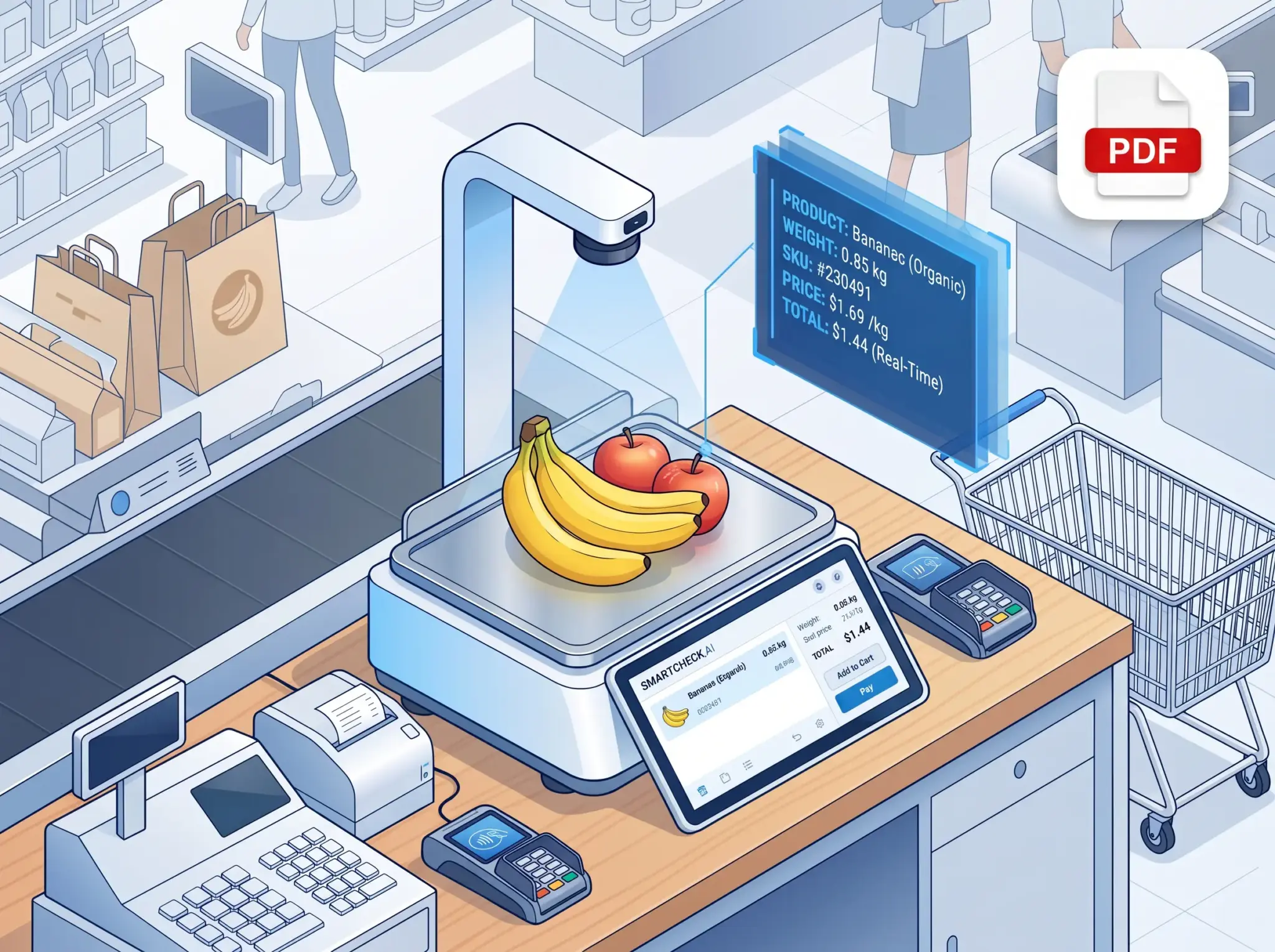
Commercial solution: iScale upgrades self-service scales and weighing terminals into a vision-powered workflow:

  • Place item → auto-recognize → confirm → print label or send to POS

Differentiators (from our internal materials):

  • 0.1s recognition speed 0.1
  • 99% candidate-list accuracy; 90%+ top-1 after learning
  • Tens of thousands of SKUs supported
  • Offline-capable; multi-OS compatibility (Windows/Android/Linux)
  • Delivery formats include SDK/service program/server/app in iScale materials

Integration note (ISV/OEM):

Your product wins when recognition maps cleanly to the item master (PLU/SKU), promotions, and receipts—and when uncertainty is handled gracefully.

🔗Explore more about the iScale solution🔗

Use case B: Self-Checkout Exception Handling (Checkout Integrity)

Problem: High throughput + minimal supervision creates exception risk and operational blind spots.

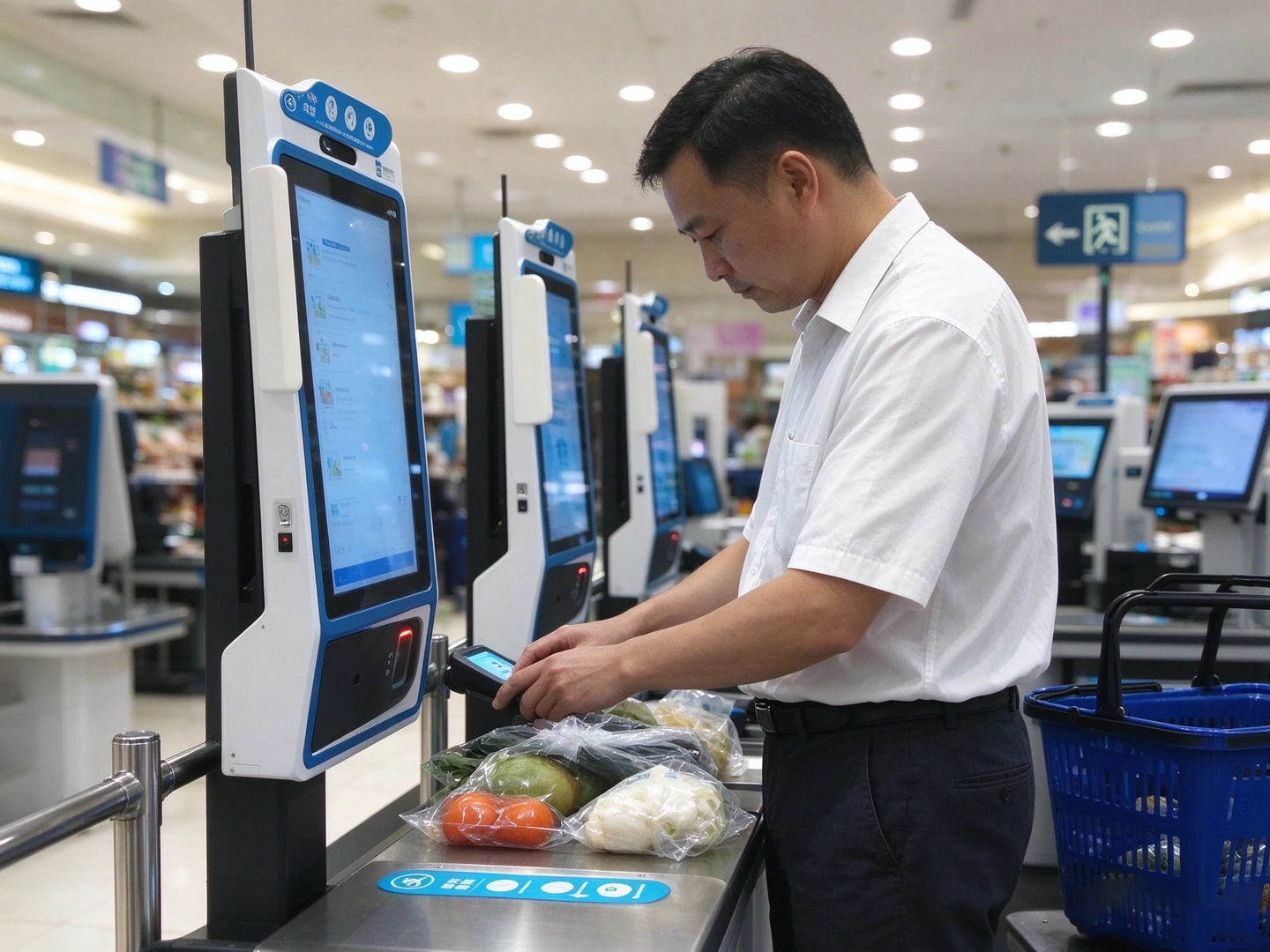
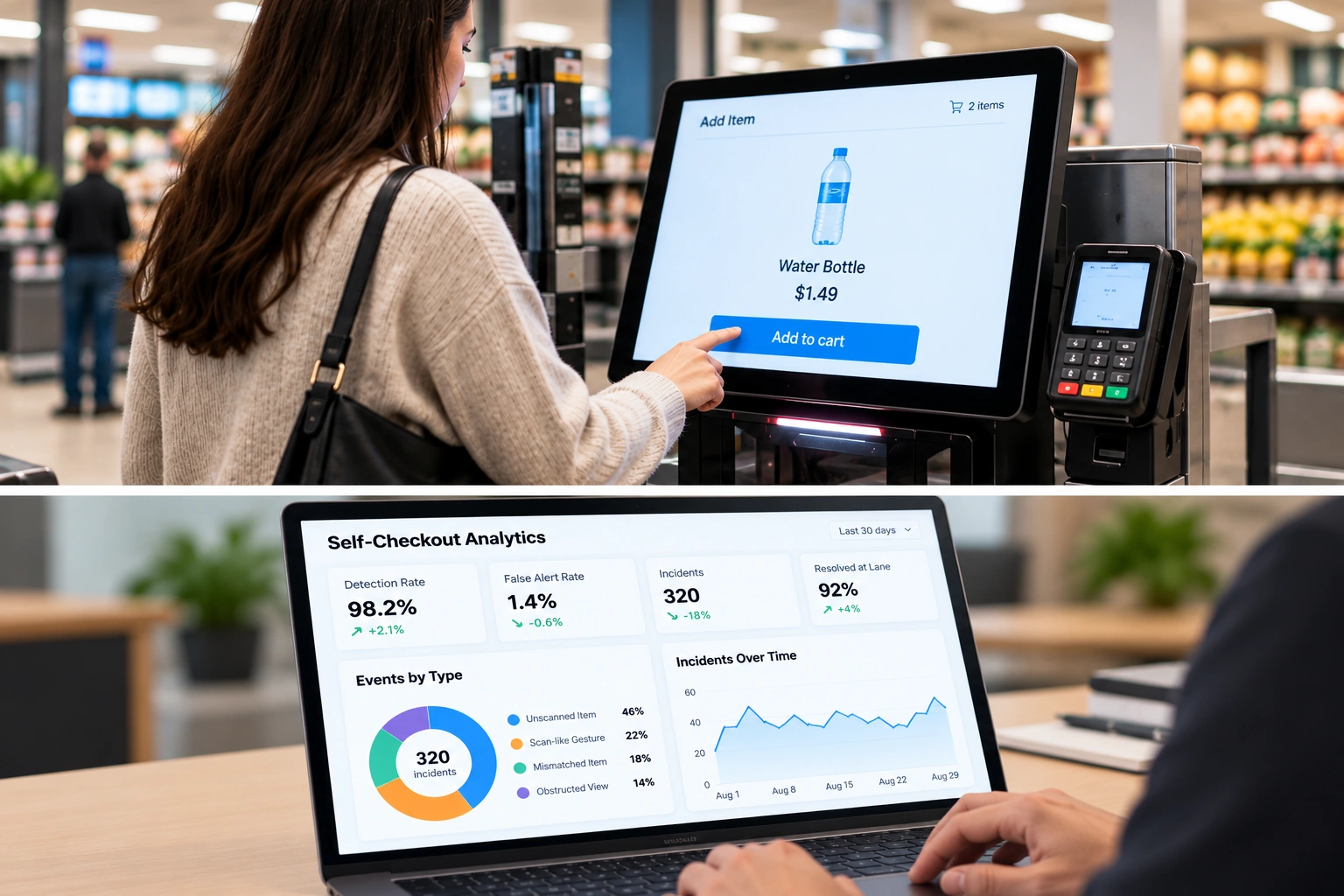
Commercial solution: iDetector combines video stream analysis with an alerting workflow:

  • Capture video signals → analyze behavior & item consistency → alert staff / log evidence

Proof points in our materials :

  • “Self-checkout share >65%” cited for large malls
  • “AI accuracy >90%”
  • Typical deployment “~10 minutes”
  • CPU envelope “~20%”
  • Detailed operational controls in manuals: trigger delay, detection interval, post-payment close detection, and “no-integration mode” options

Integration note (ISV/OEM):

Many deployments fail not because models are weak, but because false alarms and workflow friction erode trust. Operational controls are as important as accuracy.

🔗Explore more about the iScale solution

Use case C: Grocery Adjacencies (Ready-to-eat / Cafeteria / Bakery)

Problem: “search & select” at checkout is a throughput killer in peak hours.

Commercial solution: iCanteen recognizes items/trays instantly:

  • Tray enters recognition zone → instant recognition → generate checkout result

Key claims from iCanteen materials:

  • Up to 99% recognition accuracy
  • Adaptation to complex lighting/angles/placement
  • Single-photo learning for new items
  • Low-cost integration with existing POS

🔗Explore more about the iScale solution

3) Why Our Approach Is Different from Generic Vision AI Content3

Most “Vision AI for Retail” pages stop at model accuracy. Our internal materials emphasize the parts that make deployments commercially successful:

3.1 Triggered inference (to control compute cost)3.1

  • recognition can be triggered by conditions (e.g., weight delta thresholds) and called once in the unstable→stable window to avoid unnecessary CPU load.

3.2 Session + feedback loops (to improve over time)3.2

  • Interface docs include patterns like returning a sessionId and sending “confirmed results” back to improve recommendations.

3.3 Edge-first operation + offline resilience3.3

  • iScale materials explicitly discuss offline operation and low compute requirements (non-high-end chips, local inference).iScale

3.4 Deployment playbooks, not “demo scripts”3.4

iDetector materials include deployment time expectations and operational configuration knobs that keep the system usable in real stores.

4) KPIs & ROI: How ISVs/OEMs Should Quantify Value

Use KPIs that are easy to measure across stores:

For iScale (smart weighing)

  • Average time per weighing interaction (seconds)
  • % sessions requiring staff intervention
  • % confirmations that pick top-1 vs alternative
  • Rework rate (label reprints / cancellations)

Internal material examples include improvements expressed as:

  • 8s → 4s (−50%) operation time
  • ~80% → ~95% accuracy (+15 points)
  • ~100/month → 10/month (−90%) rework

For iDetector (checkout integrity)

  • Exception rate per 1,000 transactions
  • False alarm rate per hour
  • Staff response time
  • Evidence completeness rate (usable video segments)

For iCanteen (food/tray recognition)

  • Transactions per minute at peak hours
  • Recognition accuracy + top-N confirmation speed
  • Time to onboard new menu items

5) Build vs Integrate: A Practical Commercial Comparison

DecisionWhen it makes senseWhat usually breaksOur relevant proof points
Build in-houseYou have a large AI team + data pipeline + edge deployment opsTime-to-market, model iteration, and edge optimizationiScale materials cite 40–60% faster time-to-market and 30%+ lower R&D cost vs self-built approaches
Integrate modulesYou need fast GTM and reliable deploymentPOS mapping, device heterogeneity, false alarmsiScale SDK/service program; iDetector “~10 min deploy”; iCanteen “low-cost integration”


6) Implementation Blueprint (ISV/OEM Playbook)

Step 1: Choose a single “hero workflow”

  • Produce weighing (iScale)
  • SCO exception handling (iDetector)
  • Cafeteria/bakery checkout (iCanteen)

Step 2: Define interfaces & mapping

  • Item master mapping (PLU/SKU/price/tax rules)
  • Device identity & store identity
  • Event schemas (recognition result, confidence, exception type, timestamps)

Step 3: Edge deployment architecture

  • On-device inference or edge box
  • Offline mode behavior
  • Update strategy (model + item library)
  • Observability (logs, KPI dashboards)

Step 4: Pilot with measurable KPIs

Use a 2–4 week pilot window:

  • Baseline (before) → Pilot → Post-pilot measurement
  • Compare peak-hour throughput and staff interventions

Step 5: Scale with a repeatable rollout kit

  • Standard camera placement & calibration steps
  • Store staff SOP
  • Integration checklist
  • Support escalation & remote diagnostics

7. FAQ

Q: Is edge Vision AI really necessary, or can everything run in the cloud?

A: For checkout/weighing flows, latency and network variability matter. Edge inference stabilizes response time and keeps stores operating during connectivity issues.

Q: What’s the “minimum integration” for a pilot?

A: A pilot can start with local recognition + confirmation UX, then add POS item master mapping and analytics as phase 2. iDetector also has “no-integration mode” options in our manual for certain deployments.

Q: How do we avoid a false-alarm problem at self-checkout?

A: Treat operational controls as first-class features (trigger delays, cooldown intervals, post-payment handling, admin override).