table of contents
Cashierless Store Technology: Powerful Lower-Cost Lessons from Amazon Go Sensor Fusion
TL;DR
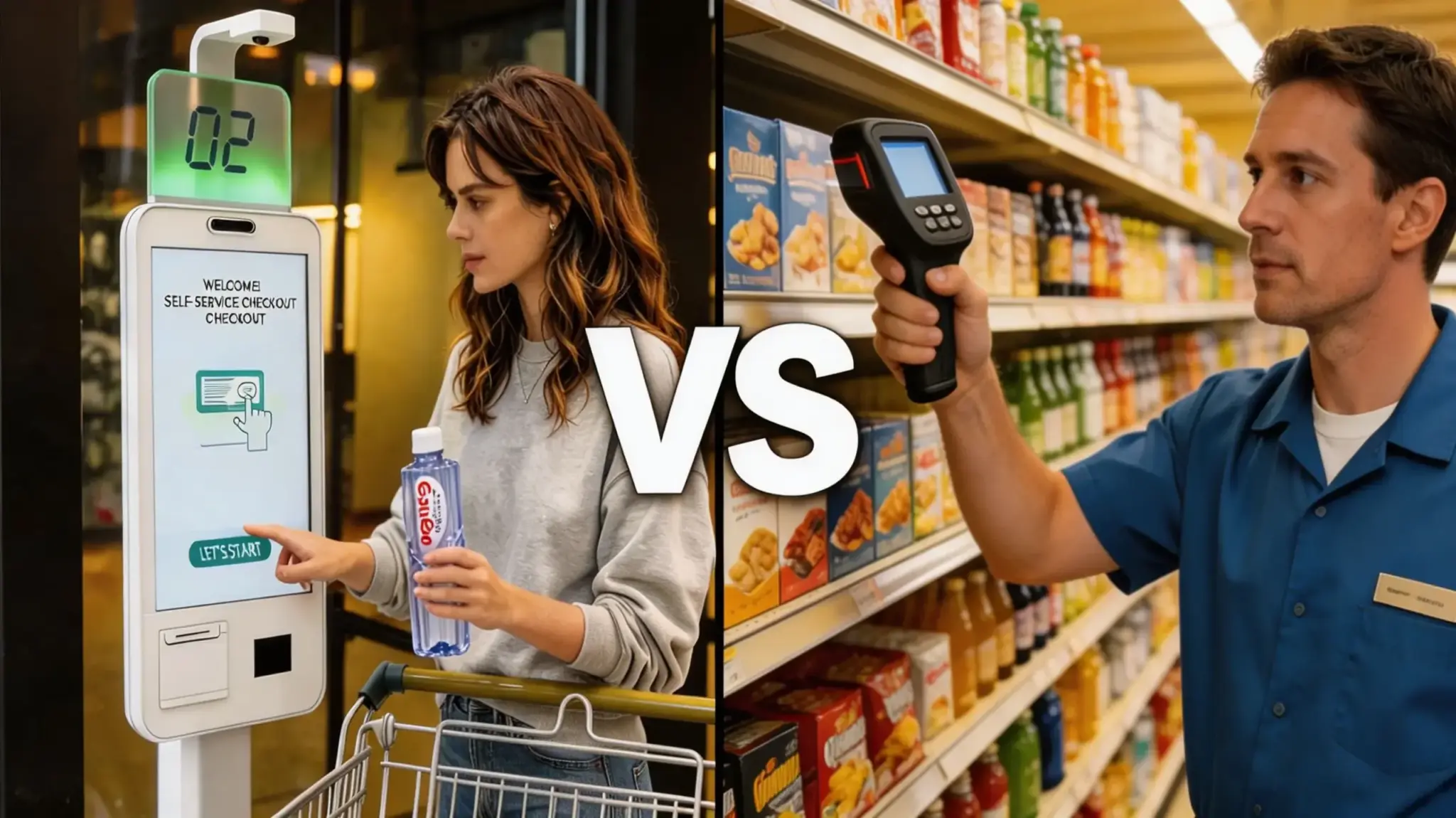
Amazon Go proved that cashierless store technology can remove the checkout line, but its sensor-fusion model is engineered for a full autonomous store: cameras, shelf sensors, AI, store mapping, product catalogs, and identity/payment flows. For many retail ISVs and hardware manufacturers, the more practical opportunity is not to rebuild the whole store. It is to add a lighter AI layer to existing self-checkout systems: detect missed scans, verify product-versus-barcode behavior, and intervene before payment.
Why This Matters for Retail ISVs and Hardware Manufacturers
Cashierless retail is attractive because the promise is obvious: fewer queues, less checkout friction, and more automated store operations. But the implementation path matters.
Amazon’s Just Walk Out technology is a benchmark for autonomous retail. AWS describes Just Walk Out as using advanced AI, sensors, computer vision, and RFID to track item selection and automate payment as shoppers leave the store. Amazon also explains that its newer model processes inputs from cameras, weight sensors, and other data simultaneously to determine “who took what,” especially in complex shopping scenarios such as camera obstruction, lighting issues, or multiple shoppers interacting with the same fixture.
That is impressive engineering. It is also a signal: full cashierless automation is a storewide sensing problem, not just a checkout problem.
For retail ISVs and hardware manufacturers, the real question is:
Do your customers need a fully autonomous Amazon Go-style store, or do they need a cost-effective way to reduce loss at the checkout points they already operate?
That distinction is where a lighter AI loss-prevention architecture becomes commercially important.
The Amazon Go Model: What Sensor Fusion Actually Solves
Amazon Go-style cashierless store technology is designed to answer one difficult question across an entire store:
Which shopper took which item, in what quantity, and should it be charged when they exit?
To answer that, the system must connect several layers of evidence:
- Shopper entry and payment association
- Shopper movement through the store
- Product pickup and return events
- Shelf or fixture interactions
- Product identity
- Quantity changes
- Virtual cart creation
- Final receipt generation
Amazon says Just Walk Out uses cameras, weight sensors, and advanced AI technologies. It also notes that the system is trained on a 3D map of the store and an image catalog of merchandise so it can understand fixtures, product placement, and visual product identity.
This is the essence of sensor fusion: no single signal is trusted alone. Cameras, shelf weight, product catalogs, fixture maps, and AI inference work together to resolve ambiguity.
For small-format grab-and-go locations, stadium stores, hospitals, airports, campuses, and convenience environments, this can be a strong fit. Amazon states that Just Walk Out is available in more than 170 third-party locations and that it expected to more than double third-party deployments in 2024.
But grocery and full-basket retail are different. Large baskets, produce, substitutions, promotions, shopper hesitation, and in-aisle browsing make the problem harder.
The Evidence: Checkout Automation Still Has a Loss Problem
The case for cashierless and self-checkout automation is not only about labor or speed. It is also about loss control.
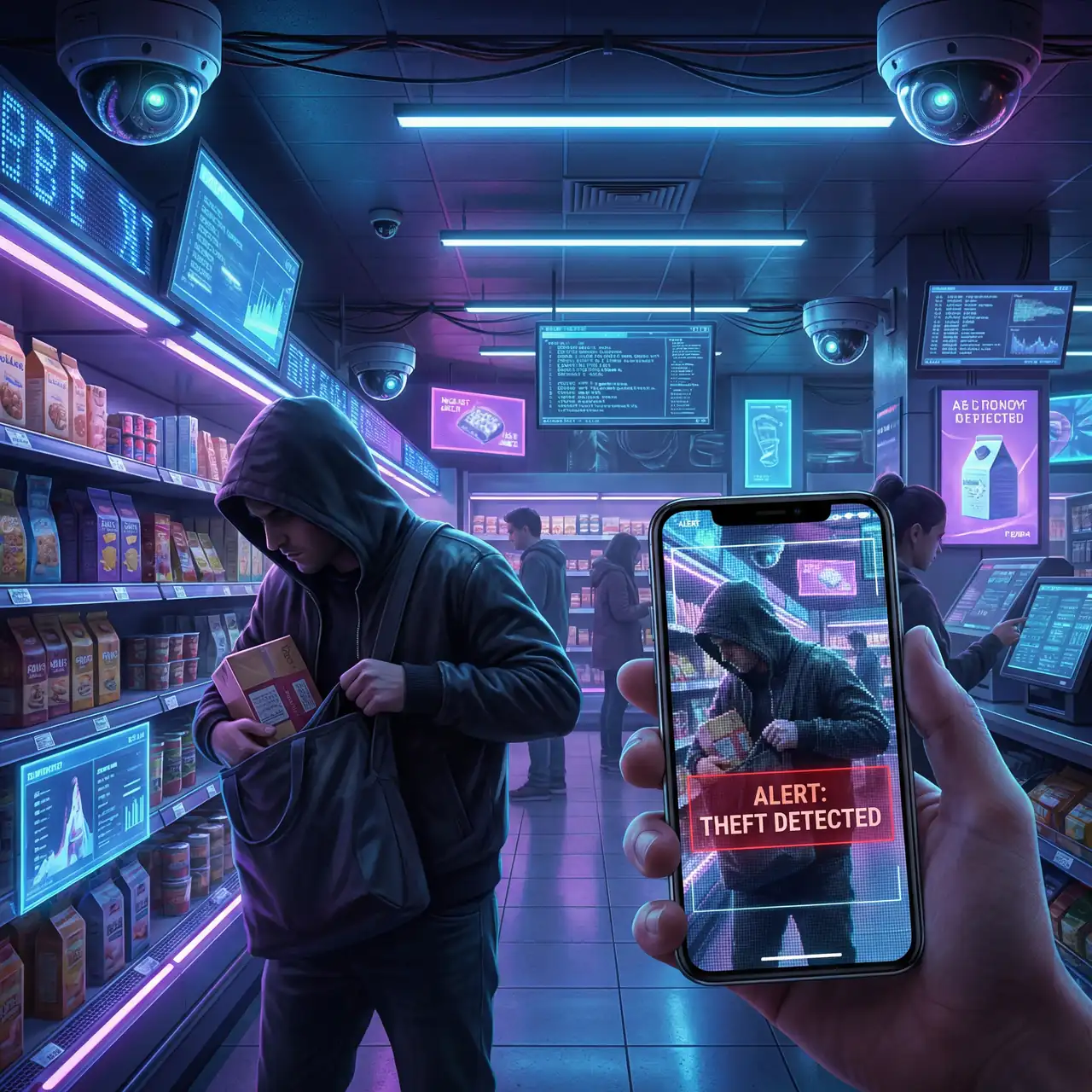
NRF’s 2023 National Retail Security Survey found that the average shrink rate increased to 1.6% in FY 2022, up from 1.4% in FY 2021. That may look small as a percentage, but at enterprise retail scale it is material.
ECR Retail Loss provides even more specific evidence for self-checkout risk:
- Fixed self-checkout can increase store losses by 30% to 60% in stores where 50% or more of transactions pass through fixed self-checkout.
- Each 1% shift of sales to fixed self-checkout can add at least one basis point of additional loss.
- Non-scanning accounts for 0.44% of self-checkout sales and 9.5% of total recorded shrink in the analyzed data.
- Full random audits found errors in 43.4% of Scan-and-Go baskets, while partial re-scan audits found errors in only 2.9%.
- Scan-and-Go losses can reach up to 4.68% of sales value in full-audit scenarios.
Those figures matter because they show the commercial tension behind checkout automation: retailers want throughput and convenience, but every new self-service flow creates a new control problem.
Cascadia Capital’s 2024 retail technology report also highlights this tension. It notes that major retailers have been reassessing self-checkout strategies because of theft concerns, customer satisfaction issues, maintenance costs, and the need for a more balanced approach combining technology with human support. The same report cites FMI data that self-checkout accounted for 44% of grocery store transactions in 2023, up from 29% in 2022.
In other words: self-checkout is not disappearing. It is being redesigned around better controls.
Why Amazon Fresh Moved Away from Just Walk Out in U.S. Grocery
Amazon did not abandon cashierless technology. It changed where the technology fits.
Retail Dive reported that Amazon is removing Just Walk Out from U.S. Amazon Fresh stores and replacing it with Dash Carts. The reason was not simply “AI failed.” Amazon said customers liked skipping checkout lines, but wanted to see nearby products and deals, view the receipt as they shopped, and understand savings during the trip.
AP News reported a similar point: Amazon still planned to sell Just Walk Out to more third-party businesses, while replacing it with smart carts in U.S. Amazon Fresh stores. Amazon’s Just Walk Out VP described the difference clearly: large grocery shoppers often want a shopping assistant that travels with them, while smaller-format shoppers are more mission-driven and want to get in and out quickly.
That is the strategic lesson for ISVs:
Cashierless store technology is not one product category. It is a spectrum of automation models.
At one end is a full autonomous store. At the other end is AI-assisted checkout loss prevention. Between them are smart carts, RFID checkout, scan-and-go, computer vision kiosks, and assisted self-checkout controls.
The Cost Advantage: Solve the Checkout Loss Problem Without Rebuilding the Store
Amazon Go-style sensor fusion solves an ambitious storewide problem. But many retailers do not need that level of infrastructure to improve self-checkout loss prevention.
For ISVs and hardware manufacturers, the lower-cost path is to focus on the highest-risk moment:
The moment an item moves through checkout and the POS transaction may not match what physically happened.
That is a narrower problem than full cashierless retail. It does not require every shelf to become a sensor. It does not require a full autonomous shopping journey. It does not require replacing the customer’s current checkout habit.
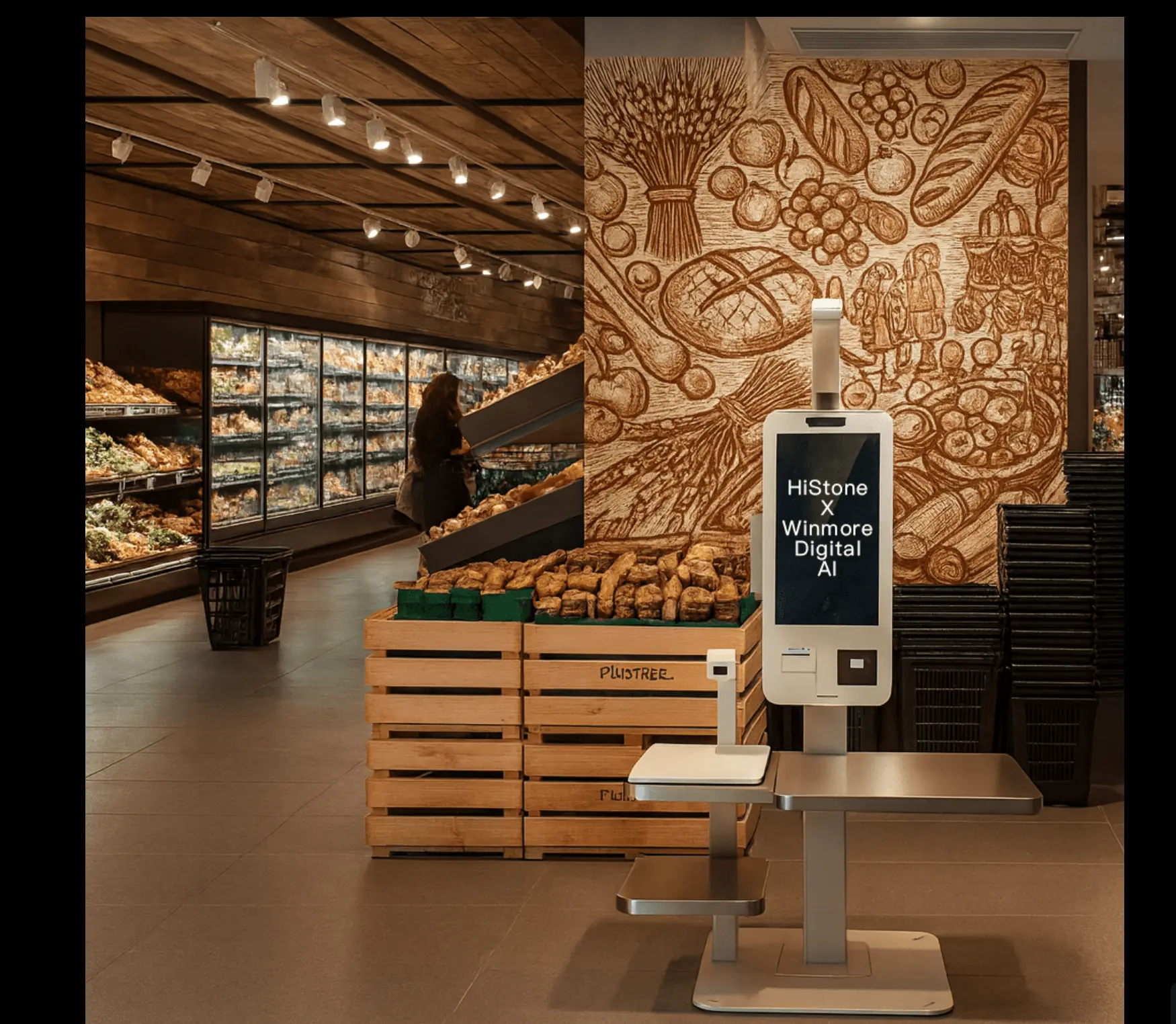
A lighter AI loss-prevention layer can work around existing checkout infrastructure:
- Existing self-checkout machine
- Existing POS or shopping cart software
- Existing barcode scanner
- USB camera or depth camera
- Local AI service or SDK
- Event callback to the ISV application
- Optional cloud or dashboard reporting
This is where iDetector’s approach differs from Amazon Go-style cashierless store technology.
Amazon Go Sensor Fusion vs. iDetector-Style AI Loss Prevention
| Dimension | Amazon Go / Just Walk Out Model | iDetector-Style AI Checkout Loss Prevention |
|---|---|---|
| Primary goal | Fully automated cashierless shopping | Reduce missed scans and wrong scans at self-checkout |
| Scope | Entire store journey | Checkout and scanning area |
| Core question | Who took what from the store? | Did the item that moved through checkout match the scan? |
| Typical sensing | Cameras, weight sensors, RFID, store maps, product catalog, AI | Camera/depth camera, barcode/PLU data, AI behavior and product verification |
| Infrastructure intensity | Storewide sensing and mapping | Checkout-focused deployment |
| Fit | Small-format autonomous stores, stadiums, campuses, grab-and-go | Existing self-checkout, POS, kiosks, ISV platforms, hardware upgrades |
| Customer experience | Walk in, take items, leave | Customer still uses self-checkout, with real-time exception prompts |
| ISV integration role | Often a full retail environment transformation | Add-on AI module for POS/self-checkout software |
| Cost logic | Higher automation ambition, higher sensing complexity | Lower retrofit burden by targeting checkout loss |
The point is not that one model is universally better. The point is that the business case is different.
If a retailer wants a fully autonomous micro-store, sensor fusion is the right category to evaluate. If a retailer already has hundreds or thousands of self-checkout lanes, the better question may be how to reduce shrink without replacing the lane.
IDetector Is Designed For Self‑Checkout Loss Prevention
Based on internal product materials, iDetector uses camera-based AI to analyze customer scanning behavior and detect missed scans, wrong scans, and abnormal checkout events. It can compare item behavior and product image signals with barcode or PLU data, then trigger alerts, voice prompts, event recording, or ISV-defined UI flows.
For retail ISVs and hardware manufacturers, the relevant capabilities include:
- Windows and Android deployment options
- Local service or SDK integration
- Integration mode for POS/self-checkout software
- Non-integration mode for faster pilots
- Barcode, PLU, and cart-line context support
- Missed-scan and wrong-scan event callbacks
- Event records with image/video evidence
- Device-level and date-level reporting
- Parameter templates for similar hardware and installation environments
- USB camera connection without large-scale store retrofit
Internal materials indicate that iDetector can support Windows 7+ and Android 7.1+ environments, with reference minimum hardware such as J1900 on Windows and RK3288 on Android. Materials also indicate typical AI risk-event recognition accuracy above 90%, depending on store environment, installation quality, product library, and parameter tuning.
That caveat is important. E-E-A-T content should not turn internal benchmarks into universal guarantees. In real stores, lighting, camera position, checkout layout, product packaging, shopper behavior, and integration quality all matter.
A Practical Evaluation Framework for ISVs
If you are a retail ISV or checkout hardware manufacturer evaluating cashierless store technology, use the following framework before choosing a technology direction.
1. Define the automation level
Ask whether your customer needs full autonomous shopping or checkout exception control.
Full cashierless stores require identity/payment entry, product pickup tracking, receipt generation, and storewide sensing. Checkout loss prevention focuses on the transaction moment: item movement, scan event, and product verification.
2. Map loss scenarios before selecting sensors
ECR Retail Loss identifies non-scanning, mis-scanning, product switching, barcode switching, and coupon abuse as key self-checkout loss modes. If the main pain is non-scanning and barcode/product mismatch, a checkout-focused AI layer may be more efficient than full-store sensor fusion.
3. Protect the customer experience
Amazon’s Fresh shift shows that shoppers may want visibility into cart totals, deals, and savings during the trip. For self-checkout, the equivalent lesson is clear: alerts should be timely, understandable, and operationally manageable.
4. Decide who owns the intervention
ISVs need to know whether the AI system will show its own pop-up or pass events into the POS UI. In most production deployments, ISV-owned UI is cleaner because it preserves the checkout experience.
5. Plan for store variability
Autonomous retail research highlights occlusion, sensor scalability, theft prevention, and real-time data processing as core challenges. Even checkout-focused systems need installation standards, calibration, thresholds, and exception handling.
6. Build the ROI around shrink reduction, not novelty
Cashierless store technology can sound futuristic, but retailers buy outcomes. The business case should connect automation to fewer missed scans, fewer wrong scans, faster interventions, measurable recovered value, and less manual video review.
Where This Fits in a Retail Loss Prevention Strategy
Cashierless and self-checkout automation should not be evaluated in isolation. It belongs inside a broader retail loss prevention strategy that includes:
- Store design
- Associate workflows
- Video evidence
- POS exception data
- Product master data
- Checkout UI design
- Customer prompts
- Audit policy
- AI-based event detection
- Reporting and continuous improvement
For a broader framework, see our pillar guide: Retail Loss Prevention: Strategies, Technologies, and AI Solutions.
Conclusion: The Future Is Not “Cashierless or Nothing”
Amazon Go made cashierless store technology visible. Sensor fusion made it technically possible. But the market is now learning a more practical lesson: different retail formats need different levels of automation.
For small autonomous stores, Amazon Go-style sensor fusion can be the right model. For mainstream self-checkout, retail ISVs and hardware manufacturers may create more near-term value by adding an AI loss-prevention layer to the checkout systems retailers already own.
That is the lower-cost, faster-deployment opportunity: close the behavior-transaction gap before payment, without rebuilding the whole store.
Explore how iDetector helps ISVs and checkout hardware partners add AI-powered missed-scan and wrong-scan detection to self-checkout systems: iDetector AI Self-Checkout Loss Prevention Solution.
FAQ
What is cashierless store technology?
Cashierless store technology allows shoppers to buy products without using a traditional cashier lane. Depending on the model, it may use computer vision, sensor fusion, RFID, smart carts, mobile scan-and-go, or AI-assisted self-checkout.
How does Amazon Go use sensor fusion?
Amazon Go-style Just Walk Out technology combines cameras, weight sensors, AI, store mapping, product catalogs, and other signals to determine which shopper took which item and generate a receipt automatically.
Is cashierless technology the same as self-checkout loss prevention?
No. Cashierless technology tries to automate the entire checkout journey. Self-checkout loss prevention focuses on detecting exceptions during scanning, such as missed scans, wrong scans, fake scans, and product-barcode mismatches.
Why might ISVs choose a checkout-focused AI layer instead of full cashierless automation?
A checkout-focused AI layer can use existing POS, barcode scanner, self-checkout hardware, and camera infrastructure. This can reduce deployment complexity for retailers that want shrink reduction without a full store redesign.
What makes iDetector relevant for retail ISVs and hardware manufacturers?
iDetector provides AI loss-prevention capabilities that can be integrated into self-checkout and POS workflows, including missed-scan detection, product-versus-barcode verification, event alerts, and reporting.