
table of contents
TL;DR
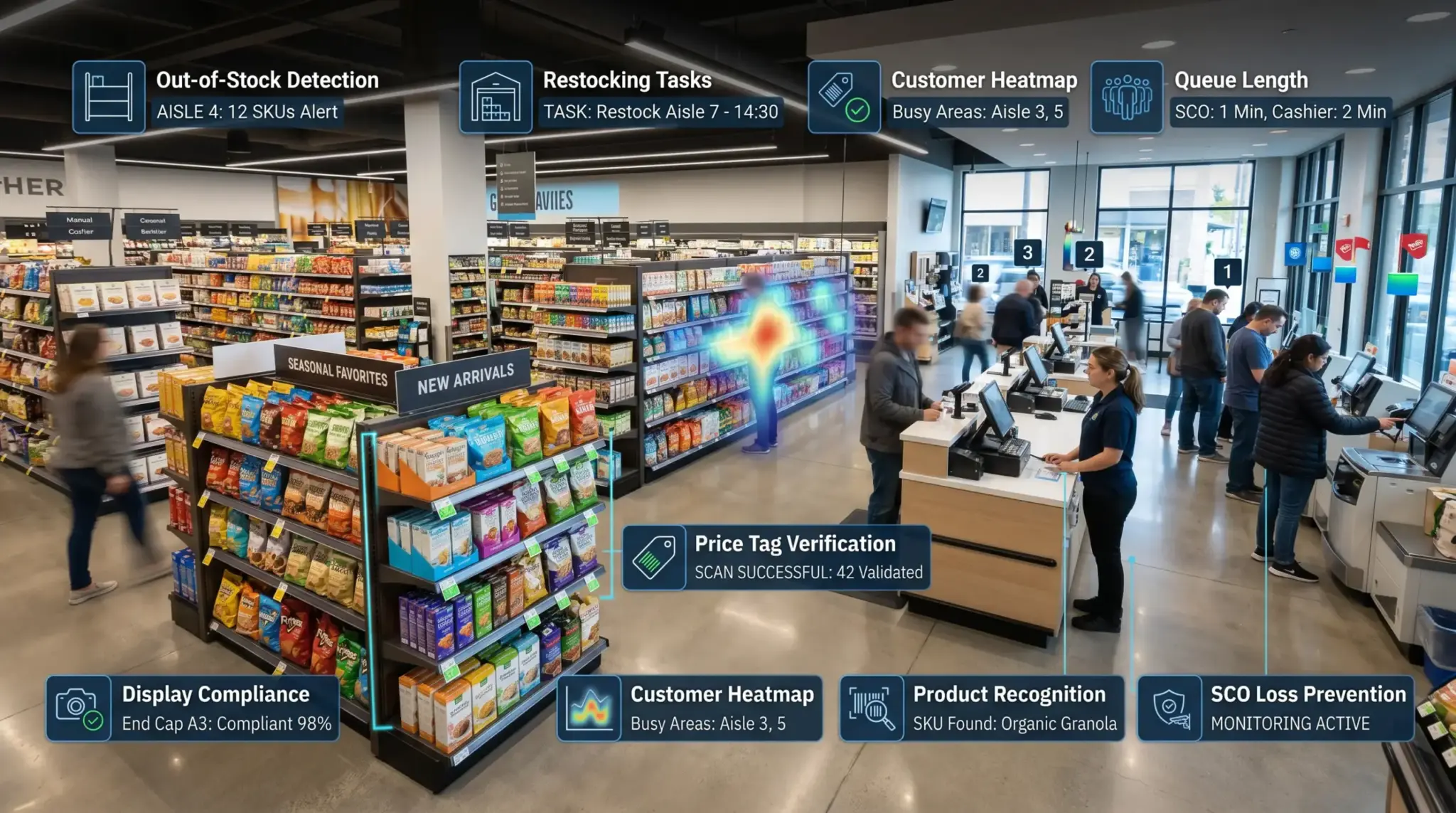
Computer vision in retail has become a store-grade capability that turns cameras into measurable operational signals. In real deployments, the most valuable systems do three things well: convert video into structured events, correlate those events with business context (POS, inventory, tasks), and drive closed-loop actions
The Retail AI Vision Stack
Retail vision systems typically combine multiple model families and an integration layer. This is why “accuracy” alone is never the deciding factor.
- Detection & tracking: people, hands, products, carts; multi-camera tracking when needed
- Fine-grained recognition: SKU/variant recognition, often supported by embeddings + similarity search
- Segmentation: better boundary understanding for dense shelves and overlapping items
- OCR: price tags, promo labels, shelf-edge text, receipts in controlled workflows
- Spatiotemporal logic: multi-frame trajectories, state machines, and rule/ML hybrids to reduce false alarms
- Edge inference + MLOps: on-prem/edge runtime, model updates, monitoring, and drift handling
- Integration: POS events, inventory master, planograms, task systems, dashboards, and evidence storage
A Practical Use Case Map
1) Shelf Availability & Replenishment
This is one of the most common “operations-first” deployments: detect shelf gaps and low fill levels, then push tasks to store associates.
- Out-of-stock (OOS) detection: detect empty shelf slots or low fill percentage and generate replenishment tasks
- Low stock and facing degradation: detect when facings drop below policy thresholds
- Cooler/cold-chain shelf monitoring: handle reflections/condensation with tuned capture and models
2) Planogram Compliance & Shelf Execution
Computer vision can compare the “realogram” (what the shelf actually looks like) against the planogram (what the shelf should look like). A large-scale example is a planogram compliance system deployed across 7,000+ convenience stores in Taiwan, using a pipeline that detects shelves, recognizes products, and aligns layouts to planograms. https://pmc.ncbi.nlm.nih.gov/articles/PMC12708730/
- Wrong placement detection: SKU in the wrong position or wrong adjacency
- Facing count compliance: ensure minimum facings for key SKUs and campaigns
- Endcap/promo display verification: verify promotional installations are present and correct
3) Product Identification at Scale
Retail product recognition is a different problem from generic object detection: it often requires SKU/variant-level identification under glare, occlusion, and packaging updates. Practical implementations typically combine detection/segmentation with embeddings and fast similarity search over a reference catalog.
- Shelf photo recognition for field audits: mobile capture → SKU mapping → gap list for on-site fixes
- Visual search: “take a photo to find the product” for customer or staff workflows (store lookup, substitution)
- New SKU onboarding: few-shot or incremental updates to reduce dataset lag
- Production-grade matching often combines embeddings with large-scale similarity search; one example describes vector search across tens of millions of product variations for grocery shelf analytics. https://www.onesixsolutions.com/casestudies/grocery-inventory-computer-vision/
4) Pricing & Label Verification
Vision + OCR can spot missing or mismatched shelf-edge labels, wrong promo tags, and unreadable labels—then route exceptions for verification.
- Missing label detection and alerting
- OCR-based price checks against a pricing database (where camera placement and image quality allow)
- Promo tag compliance checks
5) Customer Journey, Traffic, and Queue Analytics
Retailers use video analytics to bring “web-analytics-like” measurement into physical stores: footfall, dwell, heatmaps, queue length, and conversion by zone.
- Footfall & dwell time: quantify engagement by zone
- Heatmaps and “spaghetti diagrams”: understand movement paths and dead zones
- Queue measurement: detect long lines and trigger staffing actions
- Service bottleneck diagnostics: identify where checkout or assistance slows down
- Product interaction and sell-through signals: pick-up/put-back events, engagement-to-purchase proxies, display effectiveness
6) Inventory Movement & Back-of-House Visibility
Computer vision can track operational compliance in receiving and stockrooms: unauthorized access, unusual movement patterns, and process deviations. This reduces investigation time and improves auditability.
- Receiving verification workflows: confirm process steps and capture exception evidence
- Restricted-area access monitoring
- Shrink root-cause acceleration: build a timeline of events instead of searching raw video
7) Safety & Compliance
Safety use cases are often adopted because the business case is cross-functional (operations + HR + risk).
- Restricted-zone violations and after-hours intrusion
- Incident detection support (depending on policy and feasibility): falls, crowding anomalies
- SOP compliance checks in controlled environments
Loss Prevention Is Still Critical
Loss prevention remains a high-ROI domain for computer vision—especially at checkout—because it provides measurable behavior–transaction consistency. Many vendors also position POS-linked video analytics and exception reporting as the operational core.
AI Vision Use Case 1:
Self-Checkout Loss Prevention
iDetector is an AI-powered loss prevention module for self-checkout. It uses camera video streams plus barcode/transaction signals and product visual comparison to detect common SCO risks such as missed scans, wrong scans, fake scans, and occlusion-driven ambiguity. It supports real-time prompts/alerts before payment completion, structured event records (image/video), and reporting by device/date/type. It supports integration mode (SDK/local service cooperating with checkout workflow) and non-integration mode for faster pilots, with Windows and Android deployment options. Internal materials indicate accuracy can exceed 90% in suitable environments; actual performance depends on installation quality, lighting, parameter tuning, and product library readiness.
AI Vision Use Case 2:
Staffed Checkout Loss Prevention
For staffed lanes, our AI vision solution focuses on internal-risk and noncompliance patterns (for example: missed/fake scanning behaviors and abnormal cancels/voids correlated with item handling) using a non-intrusive monitoring approach that avoids disrupting checkout throughput. A practical deployment pattern is a centralized edge compute box that can process multiple cashier channels (e.g., one-to-four). It ingests lane camera streams, runs background analysis, and generates tagged incidents with key frames and short clips for audit, coaching, and investigation workflows.
Deployment Checklist
- Define the business loop first: alert → task → resolution → verification → reporting
- Choose the right capture geometry: shelf vs checkout have very different camera requirements
- Treat SKU recognition as a data program: reference catalog, packaging changes, onboarding workflow
- Prefer edge-first for latency and cost control; keep raw video local when needed
- Build privacy and governance in day one: retention, RBAC, audit logs, policy-aligned analytics
References
- NRF, The Impact of Retail Theft & Violence 2024: https://nrf.com/research/the-impact-of-retail-theft-violence-2024
- Large-scale planogram compliance study (7,000+ stores): https://pmc.ncbi.nlm.nih.gov/articles/PMC12708730/
- Grocery shelf product identification case study (vector search at scale): https://www.onesixsolutions.com/casestudies/grocery-inventory-computer-vision/