table of contents
AI vs RFID Loss Prevention: Cost, Accuracy & ROI Compared
Retailers are already using AI-powered computer vision at checkout to reduce shrink in real time. For example, in Aug 2025, German supermarket EDEKA Paschmann announced it deployed AI-powered Shrink Reduction at self-service checkouts, using cameras to detect incorrect operations and nudge shoppers to correct issues before payment.
If you’re a
- retailer
- grocery
- chain operator,
- self-checkout solution provider,
- Loss Prevention Manager
- Retail Operations Director
you’re likely comparing two very different approaches to retail loss prevention:
AI Loss Prevention to catch behavioral risk, especially at self-checkout
RFID Loss Prevention to track items and improve inventory accuracy, with limited direct theft behavior insight
This guide explains how each works, where each wins, what each costs, and when a hybrid approach delivers the best retail shrinkage prevention results.
What Is AI Loss Prevention?
AI Loss Prevention (also called computer vision loss prevention or retail surveillance AI) uses cameras and machine learning to detect suspicious events and theft patterns in real time.
How AI Loss Prevention Works
- Computer Vision: Models interpret video streams (people, carts, products, motions, zones).
- Video Analytics: Events are detected based on movement and context (e.g., item bypassing scan zone).
- Behavioral Recognition: Identifies patterns like concealment, ticket switching, or repeated “non-scan” motions.
- Real-Time Event Detection: Sends alerts to associates, security teams, or a monitoring center.
In practice, AI theft detection is less about “recognizing a stolen item” and more about spotting high-risk actions before loss occurs.
Common Use Cases
- Self-checkout theft detection (non-scan, scan-avoidance, banana trick, mis-scan)
- Sweethearting detection (cashier collusion, under-ringing)
- Product concealment (bagging/concealment before checkout)
- Employee fraud detection (refund abuse, void abuse, policy violations)
- Suspicious customer behavior monitoring (loitering, repeat patterns, ORC indicators)
What Is RFID Loss Prevention?
RFID Loss Prevention uses radio-frequency tags on merchandise and readers/antennas to identify items automatically without line-of-sight scanning.
How RFID Technology Works
- RFID Tags: A unique identifier is attached to each item (often EPC-enabled tags).
- RFID Readers: Fixed or handheld devices read tag IDs.
- RFID Antennas/Gates: Create read zones at exits, back doors, stockrooms, or dock doors.
- Inventory Platforms: Software reconciles reads with inventory records and operational workflows.
RFID is extremely strong at “Where is the item?” and “Is the item in the building?”—and less strong at “Who is doing what?”
Common RFID Applications
- Exit gate protection (alert when tagged goods leave a zone)
- Inventory tracking (store + backroom visibility)
- Stock management (cycle counts, replenishment)
- Supply chain visibility (DC-to-store traceability)
For many retailers, RFID is primarily an inventory accuracy engine that can support retail shrinkage reduction technology as a secondary benefit.
AI Loss Prevention vs RFID: Key Differences
| Feature | AI Loss Prevention | RFID Loss Prevention |
|---|---|---|
| Technology | Computer vision | Radio frequency identification |
| Hardware requirements | Cameras (often existing CCTV) + edge/cloud | Tags + readers + antennas/gates |
| Theft detection | Excellent (behavior + events) | Limited (tag presence/zone reads) |
| Behavior analysis | Yes | No |
| Inventory tracking | Limited | Excellent |
| Real-time alerts | Yes | Partial (depends on gate/zone design) |
| Scalability | High (software + camera coverage) | Medium (tagging + infrastructure scale) |
| Ongoing costs | Often lower per item | Tag costs continue + operations |
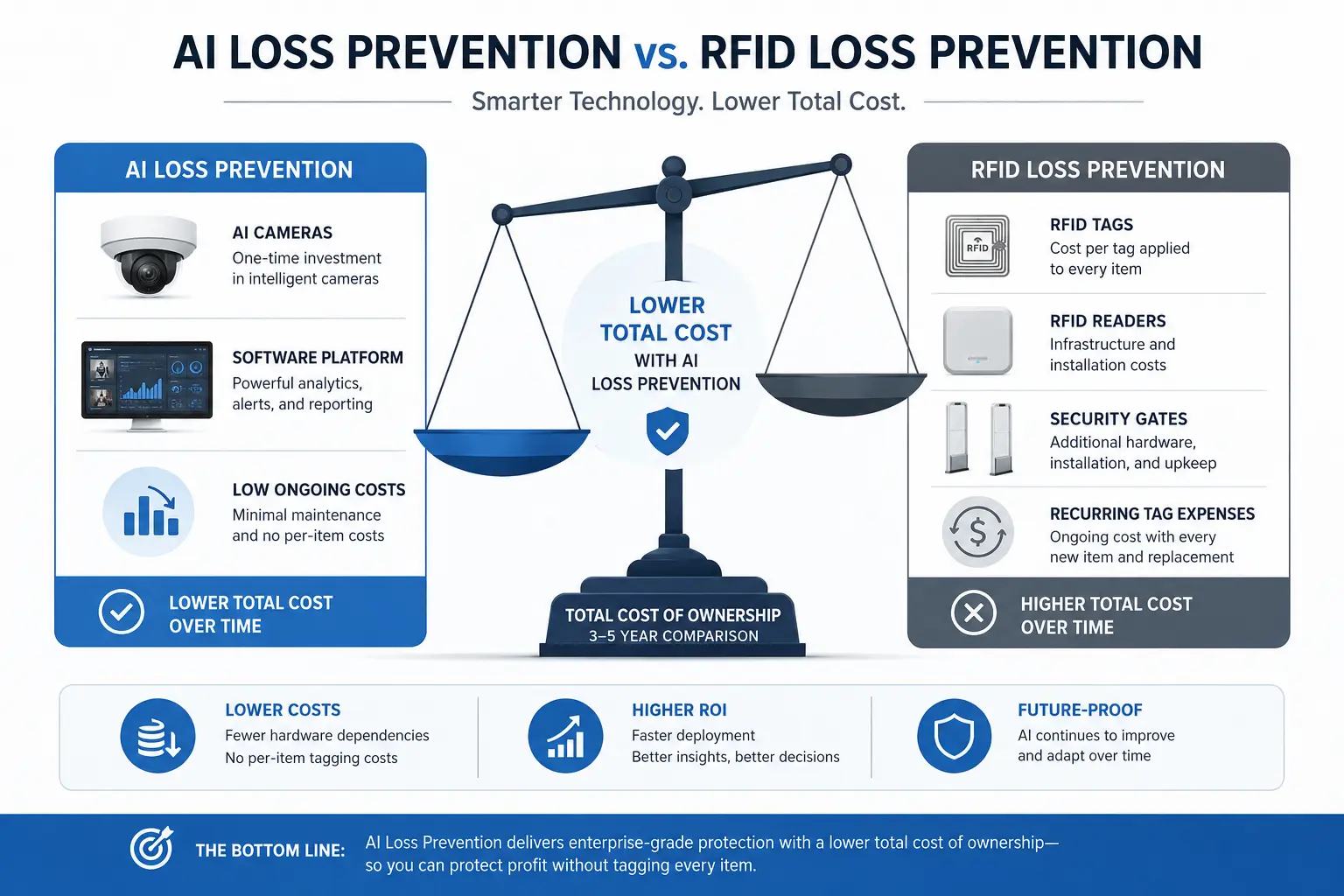
Simple rule: If your biggest pain is self-checkout shrink, AI typically pays back faster. If your biggest pain is inventory inaccuracy and omnichannel fulfillment, RFID often wins.
Benefits of AI Loss Prevention
Detect Theft Before Loss Occurs
AI can flag suspicious behavior while the shopper is still in the aisle, at SCO, or before exiting—so teams can intervene earlier and more safely.
No Need for Product-Level Tagging
Unlike RFID loss prevention solutions, many AI-powered loss prevention systems don’t require tagging every SKU, avoiding ongoing tag spend and labor.
Ideal for Self-Checkout Environments
Self-checkout is a major shrink driver for many chains. AI can focus precisely on SCO-specific behaviors: missed scans, bottom-of-basket, bypassing scan zone, and abnormal cashier-customer interactions.
For self-checkout solution providers and retail ISVs, an example is Yuanmang Digital’s iDetector—an AI-powered loss prevention module for self-checkout that combines computer vision with barcode/PLU and checkout workflow signals to detect missed scans and wrong scans, then prompts customers or alerts attendants before payment completion.
Lower Long-Term Operating Costs (When CCTV Exists)
If you already have adequate camera coverage, you may only need incremental upgrades (select cameras, networking, and compute). That can reduce total cost of ownership versus per-item tag programs.
Benefits of RFID Loss Prevention
Accurate Inventory Visibility
RFID is one of the strongest tools for near-real-time inventory awareness across stores, stockrooms, and distribution centers—especially in high-SKU environments.
Faster Inventory Audits
Handheld reads can dramatically reduce cycle count effort, enabling more frequent counts and faster discrepancy detection.
Improved Supply Chain Management
RFID supports traceability and better item-level operations from DC to store shelf—important for omnichannel accuracy, BOPIS, ship-from-store, and returns.
Proven Retail Technology
RFID has long adoption in apparel/specialty retail and continues expanding through standards-based programs (EPC/GS1). For example, GS1 highlights large-scale RFID adoption and operational use in global retail case studies.
Source: https://www.gs1us.org/industries-and-insights/case-studies/decathlon
Limitations of AI and RFID Solutions
AI Challenges
- Initial model configuration: You’ll tune detections to store layouts, camera positions, and local shrink patterns.
- Camera coverage requirements: Blind spots reduce detection quality; checkout zones need precise coverage.
- False positives in complex environments: Busy lanes, occlusion, promotional displays, and crowding require calibration and operational playbooks.
RFID Challenges
- Tagging costs: Tags are recurring cost and require operational discipline.
- Reader infrastructure investment: Gates, antennas, and tuning are not “set-and-forget.”
- Limited behavioral insights: RFID tells you item identity/location, not intent or behavior.
- Category constraints: Liquids/metal packaging and some product types can be harder depending on tag placement and read environment.
Cost Comparison: AI vs RFID Loss Prevention
When buyers search loss prevention system cost, the right answer is “it depends”—but you can model costs cleanly by separating deployment and operations.
Initial Deployment Costs
AI Loss Prevention typically includes:
- Cameras (often reuse existing CCTV, but may need upgrades in SCO zones)
- Edge devices (optional) or cloud video processing
- Software licensing (per store, per camera, per lane, or per event volume)
- Network/storage upgrades (bandwidth, retention policies)
In self-checkout environments, many buyers also evaluate whether the AI layer can run locally on existing devices (common in ISV deployments). For instance, iDetector supports Windows and Android deployment options and can be delivered as a local SDK/service for integration into POS and self-checkout products.
RFID Loss Prevention typically includes:
- RFID readers (fixed and/or handheld)
- RFID antennas and tuning
- RFID exit gates (if used)
- Integration with inventory/ERP/WMS/OMS
- Tagging program design and supplier enablement
Ongoing Operational Costs
AI Loss Prevention ongoing costs:
- Software subscription
- Model tuning and system maintenance
- Optional monitoring center costs
- Cloud compute/storage (if cloud-based)
RFID Loss Prevention ongoing costs:
- RFID tag replenishment and exceptions
- Labor for tagging/verification (if not source-tagged)
- Reader maintenance and calibration
- Software subscription and integrations
Total Cost of Ownership (TCO): 1 Year vs 3 Years vs 5 Years
Use this checklist to compare AI loss prevention ROI vs RFID economics over time:
- Year 1: RFID can be infrastructure- and program-heavy; AI can be faster if cameras exist.
- Year 3: RFID benefits accelerate when source-tagging and inventory processes mature; AI benefits stabilize once false positives are tuned and SOPs are adopted.
- Year 5: RFID remains a recurring tag + process program; AI remains a software + camera program. Your “winner” depends on whether you can keep operations consistent.
Practical TCO tip: Build a scenario model using your shrink baseline, SCO mix, SKU count, and labor rate. The biggest ROI swings usually come from (1) store adoption, (2) alert response discipline, and (3) tagging/process compliance.
Which Retailers Should Choose AI Loss Prevention?
AI is often the best loss prevention technology for retail stores when shrink is driven by behavioral theft and checkout leakage.
Ideal for:
- Grocery stores
- Convenience stores
- Big-box retailers
- Self-checkout environments
- Unmanned retail stores and micro markets
Buyers typically choose AI when they need retail theft prevention that works across many product categories without tagging every item.
Which Retailers Should Choose RFID Loss Prevention?
RFID tends to win when your operational value is tied to item-level visibility (accuracy, fulfillment, and audit speed).
Ideal for:
- Fashion retailers
- Luxury goods retailers
- Electronics stores (especially boxed, high-value goods)
- Warehouses
- Distribution centers
If your organization already has strong item master data discipline and wants to improve inventory and omnichannel outcomes, RFID can be the highest-leverage investment.
Real-World Example: AI vs RFID in Retail Shrink Reduction
Below are practical scenarios you can use to structure your own business case. (Results vary by chain, process discipline, and store format.)
Retailer A: AI-Based Loss Prevention
- Deployment scope: Self-checkout lanes + key aisles + exit zones
- Shrink reduction goal: Reduce SCO leakage and internal policy violations
- ROI logic: Faster payback when SCO mix is high and existing cameras can be reused
Retailer B: RFID-Based Loss Prevention
- Deployment scope: Item-level tagging + handheld cycle counts + DC/store visibility
- Operational improvements: Inventory accuracy, faster audits, better omnichannel fulfillment
- ROI logic: Strong when source-tagging is feasible and inventory variance drives lost sales
If you want a more detailed ROI plan, align each scenario to the shrink drivers your LP team sees weekly: SCO non-scan, concealment, refund abuse, ORC grab-and-run, back-door receiving errors, etc.
Buying Checklist: AI vs RFID for Retail Loss Prevention
Use these questions to evaluate RFID vs AI retail security comparison with real-world constraints.
1) What problem are you solving first?
- Mostly checkout leakage / behavioral theft → prioritize AI loss prevention
- Mostly inventory accuracy / omnichannel → prioritize RFID loss prevention
2) What infrastructure do you already have?
- Strong CCTV + networking → AI deployment is easier
- Mature tagging, DC discipline, supplier readiness → RFID deployment is easier
3) Who owns operations?
- AI success needs alert response SOPs and store associate adoption
- RFID success needs tagging compliance, receiving processes, and cycle count cadence
If you’re an ISV or self-checkout vendor, also verify integration fit: local SDK/service availability, event callbacks (missed-scan / wrong-scan), and whether you can embed prompts into your own UI. iDetector, for example, supports both integration mode (deeper workflow control) and non-integration mode (faster pilots with lower delivery friction).
4) How will you measure success?
- AI: SCO exception rate, intervention rate, incident resolution time, shrink by lane/store
- RFID: inventory accuracy, audit time, on-shelf availability, omnichannel fill rate, missing item investigations
FAQ
Can AI replace RFID for loss prevention?
AI can replace some RFID-driven security use cases (like exit alerts) only in certain layouts, but it generally does not replace RFID’s inventory accuracy strengths. If you need item-level visibility, RFID remains the better tool.
Is RFID effective at preventing shoplifting?
RFID can deter or detect certain events (like tagged items passing gates), but it typically provides limited behavioral detection. It’s strongest when combined with tight processes and selective gate/zone design.
What is the cost of implementing AI loss prevention?
Costs vary by camera coverage, compute approach (edge vs cloud), and licensing model (per lane, per store, per camera). Many deployments start with a pilot in high-shrink stores and expand after tuning.
Which technology delivers better ROI?
ROI depends on your top shrink drivers. AI often delivers faster ROI in self-checkout theft detection solutions, while RFID often delivers broader ROI when inventory accuracy and fulfillment losses are significant.
Can AI and RFID work together?
Yes. RFID provides item identity and movement data; AI provides behavioral context and event detection. Together they can reduce shrink and speed investigations.
What is the best loss prevention solution for self-checkout stores?
For most SCO-heavy formats, AI checkout loss prevention is the best starting point because it directly targets scan avoidance, non-scan behavior, and exception detection.